johnliddlephotography

Frozen moments from the infinity that is time


2 Comments

Contemporary Architecture in Japan

We depend on buildings for so many aspects of our daily lives such as shelter, safety and places of work, study and recreation to name a few. They are perhaps the most dominant mark that humankind has made on the planet and all buildings, regardless of size or function, started as an idea in someone’s mind. Architecture gives form to these ideas and when we travel to new places, we bring with us a natural curiosity about the architectural forms we will encounter.

So it was with my visits to Japan and although I was probably more interested in Japan’s older and more traditional buildings, I also found much of interest in its more contemporary architecture. In my last post on Shinjuku I featured a few examples, two of which are shown again here along with other selected buildings.

I have chosen to open the post with two shots (pics 1 and 2) of the Nagasaki Atomic Bomb Museum as a reminder of Japan’s diligent and ongoing commitment to world peace and as a reminder of the extensive rebuilding that was required post-war. The domed glass roof shown in pic 1 reminds me of Hiroshima’s famous domed building that stands as a monument to the horror and folly of atomic war. Similarly, the striking shadows at pic 2 invite visitors to the museum to contemplate past events as they wend their way down to the museum via the gently curving walkways.

Also utilising a lattice structure, the aptly named Mode Gakuen Cocoon Tower (pic 3) in Shinjuku houses three tertiary educational institutions (as identified in my previous post). To the bottom right of the photograph one can glimpse the adjoining dome structure, which, viewed at street level, is reminiscent of a golf ball half buried in a bunker. I’ve never really thought of buildings as “eye candy”, but this particular building jumps out and demands to be viewed.

Not far away, also in Shinjuku, one finds the towering Tokyo Metropolitan Government Building (pics 4 and 5). This truly is a colossus and although I did not find it very appealing aesthetically, its scale commands attention. The more visually appealing part of the complex is the semi-ringed structure shown at pic 2, itself of considerable scale as can be gauged from the solitary figure traversing the forecourt. Although it is an illusion I like the way the forecourt appears to be sloping away from the building.

Probably what most surprised me about Tokyo’s commercial towers was their scale and solidity. Compared to skyscrapers in cities such as New York and Chicago, the buildings in Marunouchi opposite Tokyo Station are not particularly tall. However, they sit so solidly on the ground to appear unshakeable, thus bearing witness to how architects have designed buildings to survive in an earthquake ravaged land.

As a demonstration of scale, one of my favorite shots is that of the three glass towers (pic 7), which was shot from a viewing area atop the Kitte Shoka shopping centre. The solitary figure highlighted at street level (bottom right of shot) hints at our physical insignificance, yet we must remember we are looking at the product of human imagination and construction.

Tokyo’s tallest structure is Skytree (pic 8), which, like other tall structures dominates the skyline. I recall one day being in Ueno and on impulse deciding to walk to Skytree. No maps or GPS navigation was required. All I had to do was look up and follow my nose. The structure is so dominant it did not even allow one the excuse of practicing Japanese by asking for directions. During that walk I took many photos along the way with Skytree in shot and perhaps I will post a “Finding Skytree” blog at some stage.

I mentioned Kitte Shoka a moment ago, which is a relatively new shopping centre directly across from the Marunouchi entry to Tokyo Station. As shown at pic 9, the internal design is interesting with the shops arranged on several floors following a triangular layout.

One of Tokyo’s most striking buildings is the Tokyo International Forum (pics 10 to 12) located near the boundary of Tokyo’s CBD and the Ginza shopping district. The building functions as a convention and exhibition space and is the outcome of the first international architectural competition held in Japan in 1989. Inside the building is especially magical and teases visitors to open their imaginations. Designed in the shape of a sailing boat, one could equally imagine being Moby Dick swallowed by a giant whale, or even being held within an inter-galactic spaceship.

To conclude this post that, in reality, has not even scratched the surface of contemporary Japanese architecture, I have chosen three smaller scale structures. Pic 13 can be found in Ginza and is included simply for its elegance and distinctly Japanese aesthetic. At pic 14 I have shown an external staircase attached to the FUJI television headquarters building in Odaiba because, for some reason, I felt compelled to include something brutal. In my opinion this staircase met that need. Finally, the vertical garden at pic 15 seemed an apt way to acknowledge that there is always room for nature amidst the concrete and steel.

(Please click on any of the following images for an enlarged view.)


2 Comments

Shinjuku

Most visitors to Tokyo probably think of Shinjuku for its nightlife and for its brightly lit thoroughfares ablaze with all sorts of neon signs. However, this is only one part of Shinjuku’s character and in this post I have focused not only on Shinjuku’s streets, but also on its role as a daytime business centre and the tranquility offered by the magnificent Shinjuku Goen park.

Shinjuku’s skyscrapers are prominent whenever one has a birds-eye view of Tokyo from locations such as Tokyo Tower and other vantage points. They are equally impressive from ground level and in this post I have drawn attention to three buildings that caught my attention. The first is the gargantuan Tokyo Metropolitan Government building (pics 1 and 4) that occupies three city blocks. Its scale has to be seen to be believed and it serves a useful role in getting one’s bearings when moving around the area.

The second building is the Mode Gakuen Cocoon Tower (pics 7 and 10), which is actually a vertical campus with capacity for 10,000 students. The tower houses three educational institutions: the Professional School of Fashion (Tokyo Mode Gakuen), the Special Superior School of Technology and Design (HAL Tokyo) and the Medical College (Shuto Ito). Adding further to the appeal of the building is the adjoining dome structure at street level.

The third building selected is the Sompo Japan Building (pic 13), which is said to resemble Mount Fuji with its flaring sides. The building is the headquarters of Sompo Japan – a major Japanese insurance company and I was quite surprised to learn it was constructed in 1976, such is its continuing aesthetic appeal today.

Readers will no doubt be aware that Shinjuku is also host to the world’s busiest train station used by over three million people per day. What is perhaps less well known is the presence of Shinjuku Goen Park within easy walking distance of the station, which offers an opportunity to relax in a tranquil setting unaware of the hustle and bustle outside the park’s boundaries.

To demonstrate Shinjuku’s diverse nature I have chosen to intersperse my photographs across the three subject areas of tall buildings, street shots and the park.

(Please click on any of the following images for an enlarged view.)


5 Comments

Kimono

It is almost a year since I last posted on this blog. During this time I noted that some bloggers I follow had similarly quiet years and I look forward to again reading your posts when the time is right. Others kept powering on and those I thank for their entertaining posts and inspiration.

This year I want to finish my series on Japan and thought I should start with an iconic subject, hence my choice of kimono – instantly recognisable as Japanese. I have taken a broad approach to my selection of photos by including different types of kimono from the ceremonial to the more lightweight yukata and by showing kimono worn by women of different generations.

Being of the wrong gender and nationality I can only speculate why Japanese women continue to wear kimono and at the risk of being corrected, I suspect that wearing kimono represents a connection to past generations, to Japanese culture and as an affirmation of their nationality. Other reasons might simply be that wearing kimono feels good and is something they like to do.

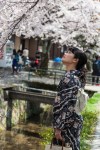
The opening shots (pics 1 and 2) show two young women engaged in viewing the cherry blossoms and my observation of each was that they were very much “in the moment”. Would wearing western clothing have lessened their experience? Only they would know, but I do know my experience was enhanced by their presence at those locations.

Shichigosan (pic 3) is a Shinto festival where three and seven year old girls in formal dress receive blessings. Unfortunately I arrived late and this is literally the only shot I was able to capture. I see a proud young girl in a splendid kimono posing for a “milestone family album” shot that, in future years, may remind her of a special day in her life. Will this experience encourage her to wear kimono in her later life? Again, only time will tell, but festivals such as Shichigosan provide important opportunities to expose children to their cultural heritage.

The closest I have come to a personal kimono experience is shown at pic 4, where this colourful arrangement occupied a corner of a tatami room at the traditional Japanese house I rented in Hiroshima. Looking at the photo brings back pleasant memories of the stay.

I have included a selection of photos (pics 5 to 8) to show that wearing kimono does not hamper everyday activities such as shopping, with women in several cities shown going about their business. My favourite from this group is the woman doing her Christmas shopping in Dotonbori (pic 5), who encapsulates the Japanese ability to combine the traditional and the contemporary; in this case kimono, modern handbag and cell phone.

One also sees many younger women in kimono, especially during times of celebration such as celebrating the autumn colours (pic 9) or simply enjoying the fantasy of dressing as a geisha for the day (pic 11). I first noticed the elegant woman in pic 12 for the furoshiki she was carrying – a simple square of cloth that can be configured for multiple uses, including carrying goods. Someone else obviously noticed her, but whether wearing kimono or not it would seem that body language tells the story.

I often walked past the teahouse in pic 13 and every time the hostess greeting patrons at the door was smiling. One could not imagine her wearing anything other than kimono. Finally I have chosen to close the post with several photos of a Shinto bride taken at Tokyo’s Meiji Jingu, whose kimono epitomises elegance.

(Please click on any of the following images for an enlarged view.)


7 Comments

Zenkoji Temple

Nagano is probably best known outside of Japan as the host city for the 1998 Winter Olympics, yet within Japan it is a different story, where an estimated six million visitors per year are attracted by Zenkoji Temple.

In fact, Nagano has grown around the temple. The temple dates back to around 522AD when the first Buddha image was brought to Japan from Korea. Known as the Ikko Sanzon statue, it is the temple’s most sacred object and is never viewed. The closest one gets to a viewing is that of a replica statue placed on view once every seven years.

The temple has moved several times in its history for security reasons, with the current building dating from 1707. Believers from all Buddhist sects are welcome – a significant reason for its popularity.

Zenkoji is one of those large sprawling temple complexes that wears signs of its feudal past and one can easily imagine blood having been spilt during its history – somewhat inevitable given the significance of the Ikko Sanzon statue.

The temple is easily reached being less than two hours by Shinkansen from Tokyo, followed by a ten-minute bus trip from Nagano Station. I would, however, recommend walking along Chou Dori from the station to the temple as genuine pilgrims would.

A short distance inside the grounds, one passes through the Niomon Gate guarded on either side by large Deva Guardians (pics 2 to 4). The sandals hanging at the front of the Gate (pic 3) are offerings from visitors, albeit a bit too small for the guardians.

As is the norm in the approach to many Japanese temples, one then passes along a walkway lined with souvenir and food shops on the way to the main building, which, as can be seen from pic 5, looms large.

I would have liked to show more shots of the main hall (Honden), but on the day I visited the officials’ discouraged internal shots, hence my offering here of only pics 6 and 7. One should not be alarmed by the prominence of the swastikas in these shots, as a backward swastika is simply the Buddhist symbol for a temple. Sometimes setbacks have a silver lining and had I lingered longer inside, I would have missed the shot of the praying hands (pic 1) that I feel is a true representation of Zenkoji.

Within the Kyozo (pics 8 and 9) is an octagonal rotating sutra holder containing a complete set of Buddhist sutras. It is believed that persons who make one full rotation of the holder will be blessed with as much religious merit as chanting all the sutras.

Of the many statues on view within the Zenkoji complex, one of the most impressive is Roku Jizo, which is situated between the Sanmon Gate (main gate) and the Honden. Roku is Japanese for six and Jizo are protectors, thus Roku Jizo are the protectors of the six realms through which all souls must pass to attain enlightenment. Each Jizo protects one of the six realms; namely hell, hungry ghosts, animals, asura, humans and heavenly beings.

The statue of Zizo-do (pic 12) is clearly that of a deity protecting children and what appeals in this photo is the contrast between a centuries old statue and the contemporary nature of the offerings made by devotees. This is yet another example of the way the Japanese seamlessly accommodate and blend the old and the new into their daily lives.

I commented earlier that Zenkoji retains the feel of a place with a bloody and turbulent past, which is supported by the memorial monument for the Sato brothers (pic 13). This is the oldest memorial stone within Zenkoji and was dedicated to two warrior brothers (Tsugunobo and Tadanobu Sato) by their Mother over 600 years ago, following their deaths in the service of their master. The respect shown to the dead is further evident in the well-maintained graveyard (pics 14 and 15), where the pagoda style building in the background of pic 14 is the Zenkoji History Museum – a relatively new structure.

A common sight at Japanese temples is the practice of visitors bathing in the incense smoke from burners, in this case (pic 16) from a massive lion incense burner outside the main hall. Finally, there are some shots I cannot resist including those of traditional Japanese wedding parties (pic 17); the serenity found in the wide passageway of a sub-temple within the grounds (pic 18); and the way that nature takes its opportunities to bless us with simple beauties (pic 19).

There is much more to discover at Zenkoji than what is shown here and as one of Japan’s great temples, I would highly recommend visiting if the opportunity presents.

(Please click on any of the following images for an enlarged view.)


6 Comments

2015 Favourites

As always the year seems to fly and 2015 now draws to an end. In blogging terms I am disappointed at my lack of discipline this year, something I will aim to remedy with more regular postings in 2016. However, it is said that “all clouds have a silver lining” and this has made it somewhat easier to select a favourite shot (or two in some cases) from each month’s posts.

There is no theme. They are simply my selections for a variety of reasons and no further commentary will be made, except to say they are shown in chronological order (January to December) should anyone wish to visit the original posts.

To those who have supported my blog this year I offer my sincere thanks and I look forward to sharing more photos and stories in 2016. Until then, I wish you all a safe and happy New Year and my best wishes for the year ahead.

(Please click on any of the following images for an enlarged view.)


Leave a comment

Shades of Japan – Part 2

As with Part 1, the selections posted here represent shots primarily taken to capture a colour and/or texture. They are, however, a more varied selection of images, some of which certainly would have stories to tell, such as the antique doll at pic 4 being handmade and given as a wedding gift to a local bride.

Similarly the shots of the head and tail of the massive fish shaped kite on display at Hida No Sato (pics 6 and 7) can only hint at how magnificent the kite would be in operation, where it would take on a life of its own moving in rhythm with the vagaries of the wind. Nevertheless, even in this static form the workmanship and subtlety of colour attract one’s attention.

Then there is the mystery of pic 11 titled “Colourful messages in Gion”. When one comes across these displays, their shape and colours cannot be ignored, yet the written messages suggest a greater significance than being of pure aesthetic value and each object is likely to contain an individual story. Whilst I cannot say precisely what the objects are called, my guess is that they are an alternative form of the Emo tablets found in shrines across Japan.

Japan is a land of many shades, both figuratively and literally and in this two-part series I have tried to show a small selection of shades that at various times and in various places caught my eye.

Finally, I would like to wish everyone a happy and safe Christmas.

(Please click on any of the following images for an enlarged view.)


2 Comments

Shades of Japan – Part 1

There are many reasons we take photographs and in this two-part post I have shown a selection of shots taken primarily to capture colour or texture. Despite being taken to aid my memory of basic colours and/or textures, each photograph has a story to tell and in some instances, a history stretching back hundreds of years. However, the purpose here is not to tell stories, but to simply share some shades of Japan.

(Please click on any of the following images for an enlarged view.


2 Comments

Karesansui

Karesansui is the Japanese word for dry landscape gardens. Introduced to Japan as landscape concepts from China and Korea around the seventh century, the form progressively evolved to take on a distinctive Japanese style. To borrow a relatively modern terminology, karesansui may be described as minimalist in their design, an approach consistent with the Japanese view that frugality is virtuous.

Karesansui are gardens for the mind, designed to encourage contemplation and meditation. From my experience of viewing karesansui I can certainly attest to their ability to induce a contemplative state of mind. Alas, my meditative skills are very limited, but one can imagine such environments being conducive to intense meditation for skilled practitioners.

I regret not having spent more time visiting and photographing karesansui, but in this post I offer a selection of shots from Kyoto’s Ryoanji and Ginkakuji temples. Ryoanji is considered to be the finest example of dry landscape gardening and Ginkakuji’s expansive Sea of Silver Sand and large (Mount Fuji) sand cone is quite unforgettable.

Photographs are a poor substitute for the real experience, but I hope you will experience a little appreciation of these wonderful and enduring gardens.

(Please click on any of the following images for an enlarged view.)


4 Comments

Streets of Asakusa

To conclude this series of posts on Asakusa I have selected shots to show what visitors may typically see if strolling the streets of this interesting and often quirky area.

Designed by Phillipe Starck, the renowned French designer, the “Flamme d’Or” (Flame of Gold) atop Asahi’s Super Dry Hall (pics 1 and 2) is difficult to miss. The Super Dry Hall takes the shape of a beer glass and is quite architecturally striking in its own right, but absolutely unmissable with the 300 ton Flamme d’Or perched like a crowning glory. The building to the left is the Asahi Beer Headquarters, with the complex of buildings occupying the site where Asahi started brewing beer over 100 years ago.

Visitors will usually spend some time walking through Shin-Nakamise (pics 4 to 7), an undercover arcade running parallel to the more famous Nakamise Dori approach to Sensoji Temple (refer to previous post).

On the outside streets there is much to catch the eye. The Nimi building, or as I prefer to call it, the Tea Cup building (pic 8) presents as an eccentric novelty. However, it is actually in keeping with Asakusa’s hosting of many businesses supplying product to the hospitality sector, an example of which is a vendor’s display of takeaway food trays (pic 9).

Translation is always good for a laugh and although the antique shop’s wares (pic 11) appear interesting, my attention was initially caught by the misspelt word (“planing” rather than “planning”). Nonetheless, I freely admit that their attempt is much better than I could manage if operating in reverse.

Tokyo must go close to being the Starbucks capital of the world (pic 15) and yes I did succumb to taking a break and enjoyed looking out over Asakusa life from an upper level vantage point. Just as Starbucks is everywhere in Tokyo, so are bicycles (pic 16) and titling the shot as “bicycle calamity” is probably unkind. What most impressed me about this and other bicycle parking I observed in Japan was the general absence of security devices to prevent theft. I read recently that one of the reasons for the low crime rate in Japan is the high proportion of travel made on foot or by bicycle and perhaps there is some credence to this argument.

I felt a bit sorry for the rickshaw operator being passed by the cyclist at pic 17, as it is was hardly a fair contest in “power to weight” terms. It never ceased to amaze me how fit the rickshaw operators are and their ability to maintain conversations with their clients while jogging along.

I have shown the house at pic 18 in a previous post on concrete buildings and am indulging myself by reposting here as an example of the innovative architecture one finds in contemporary Japanese residences. By contrast, I also offer pic 19 as an example of how small many Japanese residences are.

My farewell to Asakusa is pic 20, which serves to remind that no matter how busy and bustling life can be, water and greenery combine to create opportunities to enjoy tranquil moments.

(Please click on any of the following images for an enlarged view.)


2 Comments

Sensoji Temple – Asakusa

With an estimated 30 million visits a year from locals and tourists, it is safe to conclude that Sensoji Temple is Asakusa’s most popular drawcard. First established in 645 AD, Sensoji is Tokyo’s oldest temple and has been revered by many influential historical figures through the ages, as well as by the general population. Sensoji is devoted to the Bodhisattva Kannon who is regarded by followers as the most compassionate Buddha and is seen as a source of benevolence and relief from suffering.

Judging from my personal visits the temple is always busy, somehow befitting its background as the centre of Edo (present-day Tokyo) culture. Such busyness also fits well with Tokyo’s image as a bustling, vibrant metropolis.

Looking back from the temple steps (pic 1) through the Hozomon Gate to Nakamise Dori gives some impression of the temple’s popularity. Indeed, for some visitors it is likely that the highlight of their visits will be walking the gauntlet that is Nakamise Dori (pics 2 to 4). This is a long approach path through rows of souvenir shops and food stalls. Whilst such an approach to Japanese temples is quite common, I found Nakamise Dori to be overly commercial, though its longevity suggests that my view may be in the minority. Nevertheless, it is an interesting place to observe the contrasting and sometimes individualistic dress styles of visitors.

Japan has many impressive temple gates and the Hozomon Gate (pics 5 and 6) is yet another. First built in 942 AD, the Hozomon Gate has been destroyed twice; firstly by fire in 1631 and again in 1945 during the bombing of Tokyo. The current structure of steel-reinforced concrete houses many of Sensoji’s treasures in its second-storey; including a copy of the Lotus Sutra that is a designated national treasure. Standing almost 23 metres high, 21 metres wide and 8 metres deep, it is a commanding presence and a worthy gateway to Tokyo’s oldest temple. However, the most eye-catching feature is the large red chochin (lantern) weighing approximately 400 kilograms that hangs from the gate’s central opening.

Passing through the Hozomon Gate brings one into an area (pic 7) where official temple souvenirs and worship related materials such as amulets, incense and scrolls may be purchased, beyond which lies the temple’s main entrance. Upon entering the main hall, one’s eye is immediately diverted upwards to a series of impressive ceiling paintings (pic 8), which, despite the different subject matter, reminded me of Kyoto’s Kennin-ji (covered in a December 2014 post). Ceremonies occur throughout the day and although one’s view is generally restricted, it is always satisfying when one can experience any temple ceremony (pic 9).

Some respite from the crowds can be found within Sensoji’s gardens, which, as can be seen from the glimpse viewed from the left-hand exit of the main hall (pic 10), are quite beautiful in their own right. Within the gardens are many statues of deities, including those at pic 12 where the statue to the right of the shot is said to represent the image of the Bodhisattva Kannon. I have always found Jizo (protectors of children) statues to be rather comforting (as in pic 13) and given that Sensoji is associated with compassion, it seemed an appropriate way to conclude this post.

(Please click on any of the following images for an enlarged view.)