johnliddlephotography

Frozen moments from the infinity that is time


6 Comments

Cherry Blossoms Everywhere (Kyoto)

Objects that attract admiration and generate excitement are typically those that have a measure of rarity; yet this does not apply to Japan’s cherry blossoms, except in the sense that the season is short. Indeed, in terms of supply, cherry blossom is ubiquitous. They can be found almost everywhere. In public and private spaces; in avenues of serenely subtle colour and as solitary trees lighting up otherwise desolate places; in urban and rural areas; and in meticulously tended gardens or growing untended in their natural habitat.

Wherever they are found, they enhance the space and draw attention to their surroundings. To demonstrate this I have chosen a selection of photographs taken at various Kyoto locations, which contain two common subjects, namely buildings and cherry blossoms.

The first four photographs featuring old buildings are scenes that have doubtless been enjoyed for many seasons. The welcoming view of the Sakura blossoms framed by the temple entrance (pic 1) is an invitation to enter and enjoy an interlude of quiet contemplation. By contrast, the magnificent Sakura highlighted against the classic dark timbers of old Japanese temple buildings (pic 2) stops one in one’s tracks to enjoy the visual feast. Nevertheless, the sight of blossoms through the temple doors then draws one’s attention inwards.

The Hanami scene (pic 3) is another example of a beautiful Sakura tree, framed in this instance by the structure of the Sanmon Gate, itself the subject of an earlier post (January 27, 2014) where this photograph was previously shown. Completing the sequence of sakura and older buildings is Renge-ji (pic 4), a small temple admired for its gardens and where the Buddha statues appear to be savouring the visual feast within which they reside.

I am unsure as to the history of the old industrial building (pic 5) located near the Keage Incline – a favoured Hanami spot in Kyoto. The building’s proximity suggests it may have been part of the infrastructure for the Lake Biwa canal network, though every time I passed I couldn’t help but imagine a future life as modern loft-style apartments. Residents would wake to a wonderful view at this time of year.

Pics 6 and 7 show a wide and closer shot of Sakura trees lining the canal running alongside Kyoto’s International Exhibition Hall, where the modern architecture and the timeless Sakura coexist harmoniously in yet another example of Japan’s ability to blend the old with the new.

Following is a series of five shots (pics 8 to 12) of private residences alongside the Philosopher’s Path – another popular Hanami location, as well as a pleasant walk at any time. The Sakura show an ability to enhance various architectural styles and building materials, such as timber, corrugated metal and masonry.

This ability to enhance is further shown at pics 13 and 14, where older style buildings are lifted by the neighbouring presence of cherry blossoms in bloom. Finally, at pic 15, a contemporary apartment building is similarly lifted, suggesting that whatever direction future building developments take, there will always be a place for the ubiquitous and inspiring Sakura.

(Please click on any of the following images for an enlarged view.)


Hanami (cherry blossom viewing in Kyoto)

11 Comments

Hanami means to view the cherry blossoms and would be a frequently used word across Japan at the present time as people plan their hanami experiences before the fragile blossoms disappear for another year.

To limit the meaning of hanami to “viewing” is somewhat incomplete, as I believe careful observation of the accompanying images will reveal. Hanami is more of an appreciation and celebration, not only of the blossoms per se; but of life itself and those with whom hanami is shared. To even be a viewer of hanami, as was my position in capturing these photographs, is an uplifting experience.

If I were asked for one word to describe what I observed, the word would be “joy” – a simple yet significant word. When joy is felt, other emotions such as happiness, peacefulness, love and even reverence are brought into play.  To think that little pink/white blossoms can evoke such emotions is testament to the power of nature to build the human spirit and is, in my view, an inherent strength of Japanese culture to harness this subtle power for individual and community good.

The photographs were taken at a number of Kyoto locations, though location is insignificant in this instance. Whether located in one of Kyoto’s most sacred or most nondescript locations, the cherry blossom is appreciated. Indeed, I recall thinking during my walks through Kyoto, that the solitary trees one finds in otherwise plain areas may even have the greatest significance.

Let me discuss the photographs and I will try to be brief. The young girl crossing the narrow bridge over the canal (pic 1) is an everyday sight in Kyoto. Add the presence of cherry blossoms and her pink clothing and the image becomes poetic. Similarly, the generations passing on the bridge (pic 2) talks of the timeliness of the season’s appeal and the seasons of life.

Look closely at the faces of the businessman (pic 3) and the father with his adult daughter (my assumption) at pic 4. What do you see? Apart from more pink clothing worn by the daughter (there is a trend here); their faces show appreciation for the object of their gaze. What were they looking at? An old sakura tree, draping its blossoms over the wall of Ryoanji’s famous karesansui (pic 5). The wall alone is an object of beauty, which, during the cherry blossom season, becomes mesmerizing.

Pic 6 illustrates why the Philosopher’s Path is a time-honoured hanami location and further along the path, one finds a group of old friends sharing another hanami season at pic 7.

Hanami can be and is often enjoyed alone, as shown by the young woman (pics 8 and 9) apparently lost in admiration of the season’s blooms. What is she thinking? What is she remembering? What is she wishing for? Only she knows, but look closely at the patterns on her kimono. Could she be wearing her hanami kimono? Whatever the answer to these questions, I sense she will have remembered these frozen moments.

The season is a time for parents and children of all ages. At pic 10 we see a father tenderly supporting the tottering early steps of his daughter, experiencing what may be her first hanami. In years to come, one wonders whether she will be in a photograph such as pic 11, where two women of different generations celebrate another season, again exhibiting tenderness and love.

Communal groups also form in popular locations such as the Sanmon Gate (pic 12), where the steps form ideal viewing platforms. Hanami can even dispel myths. Anyone who thinks the Japanese are always quiet and reserved would change their views after spending time around groups like those at pics 13 and 14. Office juniors are often assigned the task of securing a location for after-work hanami celebrations and from what I observed, their efforts and lonely hours are well rewarded with convivial and loud company.

Finally, it is a season where romance can also bloom and even if short lived, it’s not every day that sharing a takeaway meal on a concrete seat can be an atmospheric experience (pic 15). Happy hanami (pic 16) is intentionally placed last, simply because it is an infectiously happy shot and if we could all have moments like this throughout each year, the world would be a happier place.

Thank you for reading and looking at my personal interpretation of a cherry blossom season in Kyoto. I hope you can see some of what I saw and I’d be delighted if you see and feel much more.

(Please click on any of the following images for an enlarged view.)


This gallery contains 16 photos


5 Comments

Cherry Blossoms (Kyoto)

My desire to experience a cherry blossom (sakura) season was born when photographing the beautiful autumn colours during my first visit to Japan. At that time the sakura trees were standing bare, yet even then one could imagine the transformation when they bloomed. Although my personal preference is probably for the autumn hues, the visual spectacle of cherry blossoms in bloom is magnificent and the atmosphere created is, of course, unique to Japan.

Cherry blossom season starts in the south in tropical Okinawa around late January and moves gradually north to end in Hokkaido around May. Being a natural phenomena, the season is naturally dependent on weather conditions, hence the interest at this time of year on news reports and websites tracking the appearance of the fragile and delicate blooms.

The viewing season is short – perhaps two weeks or less and it would seem that this symbolic reminder of the cycle of life is what has most contributed to the sakura’s place in the Japanese psyche. Life is temporary and each year the sakura provides a reminder to use our time well and an opportunity to celebrate the gift of life.

When discussing the sakura season with Japanese people, it becomes apparent that many hold special memories of their sakura experiences. I recall asking a Japanese friend what sakura meant to her and she recalled a day in Tokyo where she and her boyfriend were cycling under sakura trees as the petals gently fell to the ground. What was most impressive about the telling of her story was that she was transported back to that moment in time – such is the power of sakura.

It is now that time of year around Japan’s major population centres in central Honshu when new memories will be formed and what better time to share images from the last sakura season.  In this and successive posts, I intend to share a series of images depicting different themes of how cherry blossoms present.

For this initial post I have chosen to simply focus on their delicate beauty and invite viewers to remember similar views or imagine being there.  My images are drawn from magnificent gardens found within four of Kyoto’s many temples and shrines. The first nine images are scenes from the gardens within the Heian Shrine, which, in my opinion, had the most visually impressive sakura.  The peace and tranquility of these gardens was interrupted only by the frequent sighs of appreciation from those savouring the spectacle.

These are followed by three images (pics 10 to 12) from Ryoanji, one of my favourite places in Kyoto, with pic 12 being a particular favourite, where the solitary sakura dominates the landscape.  Ninnaji is close to Ryoanji and given that a television station was photographing the blooms on this day, perhaps these images (pics 13 and 14) were indeed taken at the peak time.  Understandably, but unfortunately, the trees could only be viewed from walkways and one was denied the pleasure of walking through the tunnels of overhanging branches shown at pic 14.

The final shots (pics 15 and 16) taken at Taizo-in present two quite different views.  Whereas pic 16 shows that a lone cherry blossom tree can command attention even within a typically beautiful Japanese garden; pic 15, where sakura blossoms have filled the hollows in the karesansui (Japanese dry garden) is fittingly symbolic of the season.

(Please click on any of the following images for an enlarged view.)


10 Comments

Tenryu-ji (Kyoto)

Tenryu-ji Temple located in Kyoto’s Arashiyama district is one of those places for which adjectives were invented.  However, perhaps pointing out that Tenryu-ji is the first ranked of the Five Great Zen Temples of Kyoto will stand as sufficient testimony to its significance through the ages.

Magnificent buildings within magnificent gardens within a delightful town make a visit to Tenryu-ji an experience to savour and remember.  My first visit was on a holiday weekend during autumn and although the crowds made it impossible to take internal shots, the communal enjoyment and celebration of the autumn colours further enhanced the experience.  An earlier post (Autumn in Japan) included several shots from Tenryu-ji and further examples of the autumn hues are shown here via the photographs of the Sogen-chi Pond.  When pondering the scene, bear in mind that by retaining the same structure since their design in the fourteenth century by Muso Soseki, these gardens have truly passed the test of time.

A return visit some weeks later on a quieter day provided an opportunity to leisurely enjoy the buildings and the interior spaces.  The use of dark, heavy timbers creates atmosphere and the joy of walking on timbers smoothed over the years by the steps of countless visitors is one of life’s simple pleasures.

Sitting on the Tatami floors in the Hojo (main hall) looking over Sogen-chi Pond to the landscape beyond is when one really appreciates this place.  The views are serene and I distinctly remember reflecting on how difficult a monk’s life would have been centuries ago, yet how apt a reward to be able to recharge one’s spirits by gazing over a view such as that still seen today.  From that moment I have thought of Tenryu-ji’s underlying character as regenerative.

A walk through the temple buildings reveals links to the past.  One such link is the image of Daruma (pic 9), the Indian Buddhist monk considered to be the founder of Zen Buddhism.  Similarly, pic 10 shows a shrine to Emperor Go-Daigo who lived and studied in a villa on the site of the present temple.  Following his death, Ashikaga Takauji (the first shogun of the Ashikaga shogunate) ordered the villa’s conversion to a Zen temple.

Of course, there is always place for fun amidst history and a popular attraction is a little ornamental pond where visitors delight in trying to land coins onto the frog statues.

(Please click on any of the following images for an enlarged view.)


4 Comments

Greater Nanzen-ji (Kyoto)

For me the starting point of a visit to Nanzen-ji is when one walks through the short pedestrian tunnel under the Keage incline, which, in the springtime, is awash with cherry blossom.  Continuing down the lane past some wonderful residences, one finds the Konchi-in temple, which has occupied its present location since 1605.

Kyoto is famous for its temples and each temple seems to have a character of its own and when I think of Konchi-in I think of harmony.  Passing through a torii gate as in pic 1 invites reflection and in this photograph I see the harmony of imperfect perfection.  Although the plantings are precise and ordered, the gardeners have followed nature’s lead.  Similarly, the seven-leaf maple cascading over the roof tiles (pic 3) matches the pattern on the circular ends of the tiles.  Finally, even the addition of an electric light fitting above the centuries-old temple door (pic 4) blends with the overall aesthetic of the gloriously weathered colours.

Continuing on to the greater Nanzen-ji complex and passing through the Sanmon Gate (refer to my last posting), one comes across the imposing Hatto Hall.  Unfortunately this lecture hall is not open to the public.  A later addition (in 1890) to the Nanzen-ji complex is the Suirokaku Aqueduct, which appears more Roman than Japanese and is part of the Lake Biwa Canal, which continues to supply more than 90% of Kyoto’s water supply.  Over the years the brick structure has aged gracefully (pics 6 to 8) and has become an attraction in its own right.

Behind the aqueduct is the Nanzen-in Temple, which I associate with a feeling of calm.  The gardens built around the main hall seem to offer an invitation to slow down and indeed, during the autumn, most people simply stop to enjoy the splendrous colours.  A glimpse is given by pics 9 to 12 and the gardens of Nanzen-in are certainly for meandering.

Finally, the Saisho-in Temple (pics 13 to 16) is a small sub-temple dating back to the eighth century and located close to the start of the aqueduct.  The space is embracing, which the inscription shown at pic 16 communicates far more ably than my words.

Perhaps I will return to some of these places in later blogs, but for now I hope you find this little glimpse of the Nanzen-ji complex interesting.

(Please click on any of the following images for an enlarged view.)


1 Comment

Sanmon Gate (Kyoto)

We are all familiar with gates … house gates, station gates, security gates etc.  Kyoto’s Sanmon Gate is altogether different.  In fact, it is a gateless entry to the most sacred part of the Nanzen-ji Temple, which has been at the core of Japanese Zen history since 1386.

The Sanmon Gate is an impressive wooden structure constructed in 1626 and supported by massive wooden pillars that dwarf those passing through its five bays.  One cannot help but feel humbled by such scale and reminded of the opportunity afforded pilgrims to free themselves from the three passions of greed, hatred and foolishness.

As will be seen from the photographs, the Sanmon Gate also serves as a meeting place and a place for reflection, particularly during the cherry blossom season when it becomes a popular platform for hanami (cherry blossom viewing).

Readers who enjoyed the movie Lost in Translation may also recognise the location from the scene where the Scarlett Johansson character (Charlotte) is entranced by witnessing a Shinto wedding group during a day trip to Kyoto.  I’ve only ever seen Shinto weddings at shrines rather than temples, but Hollywood is Hollywood and I still enjoyed the movie.

(Please click on any of the following images for an enlarged view.)


6 Comments

Fushimi Inari Shrine (Kyoto)

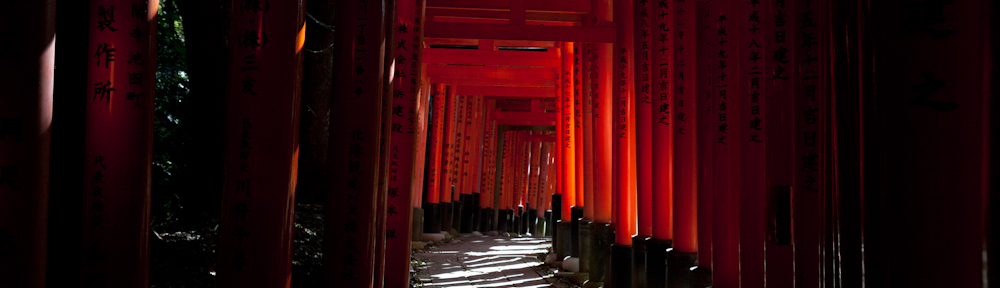
A short train journey from central Kyoto, the Fushimi Inari Shrine is one of Japan’s best known and most venerated shrines.  With its thousands of vermillion coloured torii gates, its impact is both immediate and lasting – particularly for those who allow themselves to be drawn through the gates to explore further.

Torii gates mark the entrance to Japanese shrines and there are many impressive torii gates throughout Japan.  However, nowhere else does one find so many torii in one place.  Each of the Fushimi Inari gates has been donated by a company or an individual seeking good fortune from Inari – the god of rice.

With trails leading up and around a low mountain offering wonderful views over Kyoto, a visit to Fushimi Inari can involve a lot of walking.  I found the various trails to be irresistible, which led to my becoming lost at one point and ending up outside the shrine area.  However, after teaming-up with some Mexican travelers who were similarly lost, together we found our way back.  In fact, getting lost must be easy as several Japanese people asked us for directions.  One presumes they were visiting from elsewhere in Japan.

Readers who remember the movie Memoirs of a Geisha may also remember the scene of the young Sayuri running between Fushimi Inari’s torii gates dreaming of her future life as a geisha.  Perhaps the scene had a healthy dose of poetic licence, but it nevertheless shows the ability of the location to inspire.

(Please click on any of the following images for an enlarged view.)


Leave a comment

Cafés & Coffee

For a country where the tea ceremony is an integral part of its cultural heritage, the Japanese people also appear to enjoy the pleasure of lingering over a coffee – particularly in the major cities where cafés abound.  Currently, the coffee scene is dominated by franchise operators, although one does find interesting independent cafés, which, as the coffee culture becomes more established, are likely to become more popular.

The first three photographs show examples of three popular franchises and I must say I would not be surprised if Tokyo is the Starbucks capital of the world.  They are everywhere!  The Shibuya Crossing Starbucks (pic 1) is probably the most prominent and is a great place for people watching, as is the Café Doutor (pic 2) overlooking the Ginza Crossing.

However, the variety and individuality of independent cafes can be seen from the other photographs such as Kyoto’s Café Yoshiko (pic 4) where customers can enjoy views of autumn colour and cherry blossom in season.  Similarly, the stark white minimalist look of the café in Niigata (pic 6) is so Japanese and The Deck at Harajuku (pic 7) is a great place for a warm snack and coffee.

Other places I remember fondly is Binya café (pic 8) in Ebisu.  I first came across Binya while walking to Tokyo’s magnificent Museum of Photography.  Enjoying coffee served in fine china is relaxing and a nice break from the hectic pace of life so characteristic of Tokyo and the temptation to order “takeaway”.

Wandering through Kiyojima (one of Tokyo’s old areas) led me to MuuMuu Coffee (pics 9 & 10) where I enjoyed lunch and a chat, only to learn that the barista had learnt his skills working in cafés in Melbourne (my home town).  Sometimes it truly is a small world.

My final shots are of Café Mazekoze in Nagano where I was (as usual) wandering the streets after visiting the Zenkoji Temple.  I was at first attracted by the bric-a-brac outside, but upon walking through the door I was immediately allured by the aroma of freshly brewed coffee.  Quite irresistible!  Again, conversation with the owner revealed another “small world” experience in that her sister now lives in Edinburgh – where I was born and grew up.  It is meetings like these that enrich travel and as so often happens, I left with a recommendation to visit another nearby temple.

Coffee breaks not only refresh us, but they can result in lasting memories of places visited.  I hope these photos help you to remember similar experiences.

(Please click on any of the following images for an enlarged view.)

Steps

2 Comments

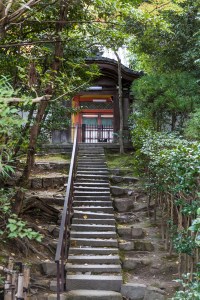
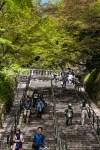
Wherever one travels there are always recurring photographic subjects.  Sometimes we seek them out and others just seem to accumulate as the trip goes on.  One of my recurring subjects was steps, though there is more as will be seen in future posts.

Steps seemed appropriate for my final post of 2013.  As we approach 2014, many people will make resolutions and set goals for the New Year, some of which will be pursued and achieved.  Reaching a goal requires taking the necessary steps and I hope that someone may find among these photographs, an image to help them focus on their goals.  If you do, please write and let me know.

The images are varied and speak for themselves.  Some were taken for their simple beauty; others such as the mum keeping a close eye on her energetic daughter are universal; and others such as the monks returning to their quarters at day’s end capture a scene that has travelled through the ages.

I wish everyone a happy, safe and successful new year and I look forward to sharing more of my photographs with you in 2014.

(Please click on any of the following images for an enlarged view.)


This gallery contains 12 photos


1 Comment

Ryoanji in Autumn

Ryoanji (the Temple of the Dragon at Peace) is located in the foothills northwest of Kyoto.  If visiting, I would recommend travelling on the small train of the Keifuku Kitano Line to enjoy a view of residential life in Kyoto.

Ryoanji is a Zen temple most famous for its karesansui (rock garden), which is said to be the finest garden of its type.  The karesansui will be the subject of a later post, though glimpses of the magnificent garden wall can be seen in photos 6 and 7.  For this post I simply want to share the beauty of Ryoanji’s other garden areas during autumn, particularly those around the Kyoyochi Pond, built in the 12th century and pre-dating the temple buildings of the late 15th century.

“I learn only to be contented” is the translation of an inscription on a stone washbasin for Ryoanji’s tea-room (not open to the public).  Zen considers those who learn only to be contented to be spiritually rich.  My hope here is less ambitious and is simply that you may find contentment in the images.

(Please click on any of the following images for an enlarged view.)