johnliddlephotography

Frozen moments from the infinity that is time


5 Comments

Nikko (Toshogu & Taiyuan Shrines)

Someone told me that Nikko is the place every Japanese person wants to visit at least once.  After visiting there twice in different seasons I came to understand why, but I had no idea how their words would resonate on my feeling that this post does not do justice to Nikko’s importance to the Japanese.

In Nikko, all roads lead to the complex including the Toshogu, Futarasan and Taiyuin shrines and it is from this complex that today’s images are drawn.  Words that may typically be used to describe Japanese temples and shrines such as subtle and understated do not apply here.  There is nothing understated about these shrines.  Quite the opposite, yet still their underlying message is that of reverence and respect for those honoured here.

Toshogu is the dominant shrine, as evidenced by the buildings of the Taiyuan Shrine being oriented to face Toshogu as a mark of respect for Tokugawa Ieyasu, the first shogun of the Tokugawa era.  As well as being the driving force behind the construction of Toshogu Shrine to honour his grandfather, Iemitsu (the third shogun) is perhaps better known as the shogun who closed Japan to foreign commerce and isolated it from the rest of the world for 200 years.

The tree-lined path to Toshogu Shrine is dominated by Ishidorii (pic 1), a granite torii gate that majestically draws one forward.  In my humble opinion, it must surely rank among Japan’s most significant torii.  To the left of Ishidorii is the five-storey pagoda (pic 2), where the storeys represent, in ascending order, the elements of earth, water, fire, wind and heaven.

Toshogu’s most famous attraction is perhaps the Sacred Stable (pics 3 and 4), or more specifically the story of stages in a monkey’s life told through a series of carvings on the walls of the building.  Since early times in Japan, monkeys have been regarded as guardians of horses, hence their significance to the stable building.  The most famous carving is, of course, that of the three wise monkeys, whose message of “hear no evil, speak no evil and see no evil” has been an aspirational refrain of parents through the ages.

Other structures of interest include my favourite, the relatively subdued Rinzo or Holy Sutra Library (pic 5), which houses a collection of valuable Buddhist scriptures; the heavily decorated Yomeimon Gate (pic 6) flanked on each side by statues of the first shogun Tokugawa Ieyasu, whose presence remains imposing (pic 7); and the designated national treasure – the Karamon Gate (pic 8).

The heavily wooded setting makes for pleasant walking and throughout the grounds one finds areas of interest such as small roadside shrines (pic 10) and many stone and metal lanterns (pic 9) donated by feudal lords.  To walk these grounds with someone steeped in Nikko history would be a pleasure, though the stories behind each building and object may require a lifetime of walks.

Although not as grand as the Toshogu Shrine, the Taiyuan Shrine is no less interesting.  Prior to climbing several sets of stairs and passing through a series of gates, one finds The Cistern for Holy Water (pic 11).  Water from a nearby stream is channeled down through a system of gutters into a solid granite basin so perfectly aligned that the water evenly overflows each edge.  Visitors stop here for purification before proceeding to the Nitenmon Gate, which can be seen in the background.

Taiyuan is built on a fairly steep slope, thus opening up vistas such as those shown (pics 12 and 13) at various points during the climb.  Reaching the upper level, one finds the largest building (pic 14), with this view showing the Ainomo or connecting chamber between the Haiden (sanctuary) and Honden (inner sanctuary).  Adjacent to the Honden is the Koukamon Gate (pic 15), the final gate behind which lies the Okunoin – the tomb of the third shogun Iemitsu.  Neither the Koukamon Gate nor Okunoin are open to the public.

Finally, walking back to central Nikko, one passes the Shinkyo Bridge (pic 16), regarded as one of the three most significant bridges in Japan.  The bridge across the Daikyo River was originally built in 1636 (rebuilt 1907) for the use of the Shogun and imperial messengers.

A visit to these sites is at first a visual assault on the senses, such is the splendour and grandeur one encounters.  However, the true value is felt by slowing down and allowing Nikko to seep into one’s senses.  One can then begin (only begin) to understand why it is so revered by the Japanese people.

(Please click on any of the following images for an enlarged view.)


4 Comments

Crossing Paths with Omikoshi (Tokyo)

This week’s post continues the chaos theme by recounting the day I kept crossing paths with an Omikoshi.

 It happened one Sunday when I visited the Nihombashi district in search of old Edo style buildings.  As is so often the case the primary objective was trumped by something more interesting.  Crossing the bridge over the river I noticed a crowd outside the Mitsukoshi department store and crowds must, of course, be investigated.  Drawing closer I could see that the focus of activity was an object I later learned to be a mikoshi, for which omiskoshi is the honorific form.

 Anyone who has experienced or seen images of Japanese matsuri (festivals) will be familiar with mikoshi.  A brief description is that they are portable Shinto shrines used to transport deities between (say) a main and temporary shrine.  They typically resemble a miniature shrine building and are often crowned with a phoenix bird statuette.  I don’t know what they weigh, but they are substantial objects and are mounted on rails to be carried by their followers.

What impressed me most was the sense of community and the happy nature of those preparing to transport the mikoshi through the streets of Nihombashi.  One often hears that Japanese people are reserved … well this was not the case on this particular Sunday in Nihombashi and everyone I approached welcomed me.  Perhaps it helped that I was the only foreigner around.

 The photographs are shown in sequence and I hope they communicate the energy of the occasion, which builds as the procession moves.  Allow me to draw attention to a few shots.  The first person I noticed through the crowd was the gentleman in “Standing Guard” (pic 3).  He did not move from his post until the procession started and he looked as if he was indeed guarding his mikoshi.  Participation is an equal opportunity as shown by “Women Power” (pic 6) and “Next Generation” (pic 10), where women and children share the load with men of all ages.  It was very much a family event and one can imagine the children in these photos being accompanied by their children in years to come.

 My favourite shot is “Success” (pic 9), where the men at the front, who had carried the mikoshi from the start showed their joy at reaching the rest stop.  Unfortunately, I must apologise for this and other shots being somewhat blurred – the result of my having been drawn into the scrum and being jostled while trying to walk backwards.  However, I’m happy to trade some blur for the experience.

 There must have been well over a hundred people involved, with fresh people taking over from others in a spirit of seamless cooperation and teamwork.  Except of course for the men at the front – they were staying the journey.  Throughout the journey the followers chant “wasshoi” over and over in a rather hypnotic rhythm and indeed, it did seem for some people to be somewhat of a spiritual experience.  By the way, I believe “wasshoi” means to share a physical load.

 From time to time I tried to resume my search for the Edo style buildings, but kept crossing paths with this and other mikoshi.  Even when I decided it was time for a refreshment break I still couldn’t escape.  Sitting at Starbucks window I had a great view of the mikoshi continuing its journey (pic 15) – they made me feel soft and lazy.

 I didn’t find the Edo style buildings, but I think the photos show the day worked out pretty well.

 (Please click on any of the following images for an enlarged view.)


4 Comments

Chaotic Calm at Shibuya Crossing (Tokyo)

Chaotic calm!  Yes, I know it sounds like a contradiction of terms.  Nevertheless, it is how I see Tokyo’s famous Shibuya Crossing.

Shibuya Crossing may very well be Tokyo’s most recognisable place given its inclusion in travel documentaries, photographs and movies such as “Lost in Translation”.  The popular vision of the crossing, where five roads intersect, is of crowds of people crossing in all directions.  All the lights change at once and when the lights change to green it is like observing an old-fashioned infantry charge.  However, rather than clash, the scene becomes one of chaotic calm.  Pedestrians and cyclists plot their course from one side to the other, artfully avoiding each other in a demonstration of humans’ innate ability to move through crowded areas with a minimum of contact.  Watching this human choreography unfold from a vantage point such as the Starbucks (pic 14) overlooking the intersection is wondrous and entertaining.

For those who like statistics, the adjoining Shibuya Station is the third busiest in the Tokyo metropolis, thus ensuring the constant supply of people crossing.  At peak hour it is estimated that approximately 2500 cross at each cycle.

The action is round-the-clock given Shibuya’s popularity as an entertainment and shopping precinct, hence any visit to Tokyo should include at least one walk across this famous crossing.

In this post I have included a few of the traditional wide shots, but have mostly tried to show a sample of the individuals one encounters.  Where have they come from?  Where are they going?  Who are they meeting?  Simple questions underscoring that each person in the frame is an individual story coming randomly together at a point in time.  A random collection that will never again be repeated.

My first photo shows Hachiko’s statue – a famous Shibuya landmark and a popular meeting point.  In brief, the statue commemorates the loyalty of a faithful dog to its owner, very similar to Edinburgh’s Greyfriar’s Bobby.  Each morning, Hachiko would walk his owner (a college professor) to Shibuya Station and return each evening to greet his owner’s return.  One day his owner did not return, which became the start of Hachiko’s long vigil of faithfully waiting for the impossible.  Local traders and family members cared for him as best they could, but eventually he succumbed to age and the elements.  This bittersweet story has been captured in the movie “Hachiko – A Dog’s Story” starring Richard Gere.  Well worth a look!

The remaining photos are a small sample of whom you might see during a visit to Shibuya Crossing.  If you see yourself in any of the pics, please let me know and I hope I caught you from a good angle haha.

(Please click on any of the following images for an enlarged view.)


10 Comments

Tenryu-ji (Kyoto)

Tenryu-ji Temple located in Kyoto’s Arashiyama district is one of those places for which adjectives were invented.  However, perhaps pointing out that Tenryu-ji is the first ranked of the Five Great Zen Temples of Kyoto will stand as sufficient testimony to its significance through the ages.

Magnificent buildings within magnificent gardens within a delightful town make a visit to Tenryu-ji an experience to savour and remember.  My first visit was on a holiday weekend during autumn and although the crowds made it impossible to take internal shots, the communal enjoyment and celebration of the autumn colours further enhanced the experience.  An earlier post (Autumn in Japan) included several shots from Tenryu-ji and further examples of the autumn hues are shown here via the photographs of the Sogen-chi Pond.  When pondering the scene, bear in mind that by retaining the same structure since their design in the fourteenth century by Muso Soseki, these gardens have truly passed the test of time.

A return visit some weeks later on a quieter day provided an opportunity to leisurely enjoy the buildings and the interior spaces.  The use of dark, heavy timbers creates atmosphere and the joy of walking on timbers smoothed over the years by the steps of countless visitors is one of life’s simple pleasures.

Sitting on the Tatami floors in the Hojo (main hall) looking over Sogen-chi Pond to the landscape beyond is when one really appreciates this place.  The views are serene and I distinctly remember reflecting on how difficult a monk’s life would have been centuries ago, yet how apt a reward to be able to recharge one’s spirits by gazing over a view such as that still seen today.  From that moment I have thought of Tenryu-ji’s underlying character as regenerative.

A walk through the temple buildings reveals links to the past.  One such link is the image of Daruma (pic 9), the Indian Buddhist monk considered to be the founder of Zen Buddhism.  Similarly, pic 10 shows a shrine to Emperor Go-Daigo who lived and studied in a villa on the site of the present temple.  Following his death, Ashikaga Takauji (the first shogun of the Ashikaga shogunate) ordered the villa’s conversion to a Zen temple.

Of course, there is always place for fun amidst history and a popular attraction is a little ornamental pond where visitors delight in trying to land coins onto the frog statues.

(Please click on any of the following images for an enlarged view.)


4 Comments

Greater Nanzen-ji (Kyoto)

For me the starting point of a visit to Nanzen-ji is when one walks through the short pedestrian tunnel under the Keage incline, which, in the springtime, is awash with cherry blossom.  Continuing down the lane past some wonderful residences, one finds the Konchi-in temple, which has occupied its present location since 1605.

Kyoto is famous for its temples and each temple seems to have a character of its own and when I think of Konchi-in I think of harmony.  Passing through a torii gate as in pic 1 invites reflection and in this photograph I see the harmony of imperfect perfection.  Although the plantings are precise and ordered, the gardeners have followed nature’s lead.  Similarly, the seven-leaf maple cascading over the roof tiles (pic 3) matches the pattern on the circular ends of the tiles.  Finally, even the addition of an electric light fitting above the centuries-old temple door (pic 4) blends with the overall aesthetic of the gloriously weathered colours.

Continuing on to the greater Nanzen-ji complex and passing through the Sanmon Gate (refer to my last posting), one comes across the imposing Hatto Hall.  Unfortunately this lecture hall is not open to the public.  A later addition (in 1890) to the Nanzen-ji complex is the Suirokaku Aqueduct, which appears more Roman than Japanese and is part of the Lake Biwa Canal, which continues to supply more than 90% of Kyoto’s water supply.  Over the years the brick structure has aged gracefully (pics 6 to 8) and has become an attraction in its own right.

Behind the aqueduct is the Nanzen-in Temple, which I associate with a feeling of calm.  The gardens built around the main hall seem to offer an invitation to slow down and indeed, during the autumn, most people simply stop to enjoy the splendrous colours.  A glimpse is given by pics 9 to 12 and the gardens of Nanzen-in are certainly for meandering.

Finally, the Saisho-in Temple (pics 13 to 16) is a small sub-temple dating back to the eighth century and located close to the start of the aqueduct.  The space is embracing, which the inscription shown at pic 16 communicates far more ably than my words.

Perhaps I will return to some of these places in later blogs, but for now I hope you find this little glimpse of the Nanzen-ji complex interesting.

(Please click on any of the following images for an enlarged view.)

Steps

2 Comments

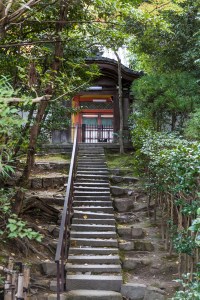
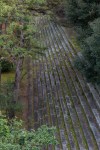
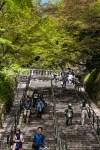
Wherever one travels there are always recurring photographic subjects.  Sometimes we seek them out and others just seem to accumulate as the trip goes on.  One of my recurring subjects was steps, though there is more as will be seen in future posts.

Steps seemed appropriate for my final post of 2013.  As we approach 2014, many people will make resolutions and set goals for the New Year, some of which will be pursued and achieved.  Reaching a goal requires taking the necessary steps and I hope that someone may find among these photographs, an image to help them focus on their goals.  If you do, please write and let me know.

The images are varied and speak for themselves.  Some were taken for their simple beauty; others such as the mum keeping a close eye on her energetic daughter are universal; and others such as the monks returning to their quarters at day’s end capture a scene that has travelled through the ages.

I wish everyone a happy, safe and successful new year and I look forward to sharing more of my photographs with you in 2014.

(Please click on any of the following images for an enlarged view.)


This gallery contains 12 photos


4 Comments

Hida No Sato

The Hida Folk Village (Hida No Sato) is located in the town of Takayama and is best described as a living museum of traditional houses relocated from around the Hida region.  Although the region is agriculturally poor, its mountain location has provided access to other resources – principally timber and water.  These in turn have historically produced highly skilled carpenters whose craft is evident in the Edo Period (1603 – 1867) houses within the village and a long established sake brewing industry built around the area’s pure water supply.

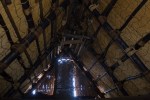
Exploring Hida No Sato is to step back in time.  Fires are lit daily in the hearths of each house to help preserve the houses and add further atmosphere.  The first photograph shows examples of Gassho style buildings, which take their name from their steeply sloping thatched roofs resembling “gassho” (praying hands).  An internal view of this style (photograph 12) shows the intricate workmanship and how the ends allow air and light to circulate, conditions essential to silkworm cultivation.

I found it comforting to know that these old wooden houses will live on as a living example of a bygone era.  Finally, thanks for reading my blog and I wish you a very happy Christmas.

(Please click on any of the following images for an enlarged view.)


1 Comment

Ryoanji in Autumn

Ryoanji (the Temple of the Dragon at Peace) is located in the foothills northwest of Kyoto.  If visiting, I would recommend travelling on the small train of the Keifuku Kitano Line to enjoy a view of residential life in Kyoto.

Ryoanji is a Zen temple most famous for its karesansui (rock garden), which is said to be the finest garden of its type.  The karesansui will be the subject of a later post, though glimpses of the magnificent garden wall can be seen in photos 6 and 7.  For this post I simply want to share the beauty of Ryoanji’s other garden areas during autumn, particularly those around the Kyoyochi Pond, built in the 12th century and pre-dating the temple buildings of the late 15th century.

“I learn only to be contented” is the translation of an inscription on a stone washbasin for Ryoanji’s tea-room (not open to the public).  Zen considers those who learn only to be contented to be spiritually rich.  My hope here is less ambitious and is simply that you may find contentment in the images.

(Please click on any of the following images for an enlarged view.)

Autumn in Japan

5 Comments


Irrashaimase or welcome to my first post.  It’s now Autumn in Japan, so it seems right to share some photographs of the seasonalAutumn colours.  Science may explain the colour changes as a chemical reaction to trees shutting-off nutrition to the leaves, but I prefer to think of it more simply as nature’s way.  To survive the winter it is necessary to shed, but not before putting on a spectacular colour display to awe all who witness it.  

To say the Autumn colours are celebrated is an understatement.  I was totally unprepared for the number of people of all ages who flock to gardens, parks and temples, particularly at weekends and public holidays, to enjoy the annual visual feast.  However, this adds to the experience and demonstrates how integral the seasons are to the Japanese culture and lifestyle.  Indeed, one feels some envy that such a natural phenomenon as seasonal change is so appreciated and that community pleasure is derived from such a natural and recurring event.  Of course, Japan has the advantage of enjoying four distinct seasons – an advantage not shared by all countries.  Nevertheless, there is a lesson to be learned from Japan’s appreciation of nature.

I do have one wish though and that is that the authorities would be less efficient in clearing away the fallen leaves.  They make a beautiful carpet and one of life’s little pleasures is walking through a carpet of rustling leaves no matter what age we are.  Enjoy!

(Please click on any of the following images for an enlarged view.)