johnliddlephotography

Frozen moments from the infinity that is time


2 Comments

Sensoji Temple – Asakusa

With an estimated 30 million visits a year from locals and tourists, it is safe to conclude that Sensoji Temple is Asakusa’s most popular drawcard. First established in 645 AD, Sensoji is Tokyo’s oldest temple and has been revered by many influential historical figures through the ages, as well as by the general population. Sensoji is devoted to the Bodhisattva Kannon who is regarded by followers as the most compassionate Buddha and is seen as a source of benevolence and relief from suffering.

Judging from my personal visits the temple is always busy, somehow befitting its background as the centre of Edo (present-day Tokyo) culture. Such busyness also fits well with Tokyo’s image as a bustling, vibrant metropolis.

Looking back from the temple steps (pic 1) through the Hozomon Gate to Nakamise Dori gives some impression of the temple’s popularity. Indeed, for some visitors it is likely that the highlight of their visits will be walking the gauntlet that is Nakamise Dori (pics 2 to 4). This is a long approach path through rows of souvenir shops and food stalls. Whilst such an approach to Japanese temples is quite common, I found Nakamise Dori to be overly commercial, though its longevity suggests that my view may be in the minority. Nevertheless, it is an interesting place to observe the contrasting and sometimes individualistic dress styles of visitors.

Japan has many impressive temple gates and the Hozomon Gate (pics 5 and 6) is yet another. First built in 942 AD, the Hozomon Gate has been destroyed twice; firstly by fire in 1631 and again in 1945 during the bombing of Tokyo. The current structure of steel-reinforced concrete houses many of Sensoji’s treasures in its second-storey; including a copy of the Lotus Sutra that is a designated national treasure. Standing almost 23 metres high, 21 metres wide and 8 metres deep, it is a commanding presence and a worthy gateway to Tokyo’s oldest temple. However, the most eye-catching feature is the large red chochin (lantern) weighing approximately 400 kilograms that hangs from the gate’s central opening.

Passing through the Hozomon Gate brings one into an area (pic 7) where official temple souvenirs and worship related materials such as amulets, incense and scrolls may be purchased, beyond which lies the temple’s main entrance. Upon entering the main hall, one’s eye is immediately diverted upwards to a series of impressive ceiling paintings (pic 8), which, despite the different subject matter, reminded me of Kyoto’s Kennin-ji (covered in a December 2014 post). Ceremonies occur throughout the day and although one’s view is generally restricted, it is always satisfying when one can experience any temple ceremony (pic 9).

Some respite from the crowds can be found within Sensoji’s gardens, which, as can be seen from the glimpse viewed from the left-hand exit of the main hall (pic 10), are quite beautiful in their own right. Within the gardens are many statues of deities, including those at pic 12 where the statue to the right of the shot is said to represent the image of the Bodhisattva Kannon. I have always found Jizo (protectors of children) statues to be rather comforting (as in pic 13) and given that Sensoji is associated with compassion, it seemed an appropriate way to conclude this post.

(Please click on any of the following images for an enlarged view.)


2 Comments

Looking for Old Tokyo – Mukojima

Mukojima adjoins Kyojima and was, therefore, a logical area to look for examples of old Tokyo. Located on the east side of the Sumida River, Mukojima was fortunate during the 1945 bombings to avoid the extent of devastation experienced elsewhere. Whilst this has resulted in well-preserved shitamachi (low town) zones, there is also much evidence of an area in transition as new developments have followed the opening of the nearby Tokyo Skytree in 2012.

There was a second agenda to my walk through Kiyojima and that was to find geisha, given that Mukojima is one of the few areas in Tokyo where real geisha train and work. I could have joined an organised tour and been guaranteed success, but I much preferred to simply wander and trust in luck and instinct. As can be seen from pics 11 to 14, the mission was accomplished.

After wandering the streets for some time I came across an area that just felt right and decided to wait on a corner and play “paparazzi”. Well, after a short time I heard the familiar clip clopping sound of footsteps and the jangling associated with the hair ornamentation worn by trainee geisha on their way to engagements. A short while later an older woman came by (pic 14) carrying her shamisen, a stringed instrument used to accompany geisha during performances.

This post marks my 50th post and although it has taken longer than I had expected, I would like to thank those people who follow, read and comment on my blog. Your participation is most appreciated and I hope you will continue to find the blog interesting.

(Please click on any of the following images for an enlarged view.)


2 Comments

Looking for Old Tokyo – Kyojima Shopping Street

I concluded my previous post by describing Kyojima as a place with a “village feel” and this is most evident by spending time in Kyojima’s shopping street. I’m unsure as to the street’s name, but I think it is Tachibana Ginza, though my advice is to just wander around Kyojima and you will find it, as I suspect all streets lead to the shopping street (shotengai).

Despite enjoying my base in Harajuku during my stay, I wished Harajuku had such a place to shop for fresh foods and it is a reminder that streets like these are under threat in all developed societies. It is such a shame that future generations may never experience the sense of community from buying their everyday needs from merchants who rely more on friendly relationships than slick marketing programs. At a personal level, I recall my Father’s butcher shop being a social hub where people would share local news (and gossip of course), not to mention his knowledge of customers’ favourite cuts ensuring their ongoing patronage. The shrink-wrapped equivalent from the supermarket is …. well it’s not an equivalent at all is it?

Kyojima’s shotengai is old Tokyo, yet it fits new Tokyo if one listens to Kyojima’s newer residents. Urban planning is always a difficult and challenging process, yet one hopes a way can be found to retain these old shotengai within the inevitable urban renewal process. Given Japan’s reverence for maintaining old traditions, it is perhaps more likely to succeed than other nations.

Today’s photos start with MuuMuu Coffee (pics 1 and 2), which also features in an earlier post (Cafes on January 6, 2014), followed by a selection of shots showing shopkeepers and customers. I was quite taken by the wheelchair bound woman (pic 3) enjoying a relaxing shopping expedition accompanied, one assumes, by her son. Can one be this relaxed in a food hall?

Much as the wares on display in Ginza’s food halls impress me, is not the timeless appeal of Toshi’s greengrocery (pic 4) just as impressive? The personalised service and sense of community is aptly conveyed by pics 7 and 8, where Yumiko can be seen attending to an elderly customer (pic 7) and enjoying a chat with a local resident (pic 8). Yumiko’s café serves a range of popular snacks including takoyaki (octopus balls) and taiyaki, which are fish shaped cakes served with hot fillings such as red bean paste.

Perhaps pic 9 is most reminiscent of old Tokyo through the photographic memories on display. I would like to be able to tell you more about this shop, but it was untended each time I passed. Pics 10 and 11 are shots of students visiting from Kanazawa to promote their city. I remember them well. My presence became an opportunity for English practice and it was fortunate I had visited Kanazawa a few days earlier.

I suspect most visitors to Tokyo would not visit this shotengai and I hope this post may encourage more visitors. Visiting the Ginza and Kyojima’s shopping street may be at opposite ends of the shopping spectrum, but each is a “wow” experience.

(Please click on any of the following images for an enlarged view.)


2 Comments

Looking for Old Tokyo – Kyojima

How well do you really know your city? Perhaps the answer depends on the size and population as much as any other factor and for those who live in large cities, I suspect there are many areas that are rarely visited. I know this applies to my life in a city of approximately 4.4 million people. Extrapolating this to a sprawling metropolis such as Tokyo suggests that vey few Tokyoites would have an intimate and comprehensive knowledge of their city. For tourists and short-term residents, the challenge of seeing the range of cities within a city is even greater.

One of the things I was keen to do when visiting Tokyo was to visit areas where “old Tokyo” could still be seen and experienced, though I freely admit that I was barely able to scratch the surface. The plan was simple: catch a train to areas of interest and wander around.

This will be the first in a series of “Looking for Old Tokyo” posts, starting with Kyojima, originally designated as a farming area according to old shogunate law. This heritage is most visibly experienced, quite delightfully, by strolling through Kyojima’s narrow winding streets that follow the pathways through long gone paddy fields and irrigation channels. This was aptly described as Kyojima epitomising Tokyo in the sense that Tokyo is a city that has never had a plan, a city centre or any visible order.

Kyojima is also described as an accident waiting to happen. It sits at sea level; has many older style wooden houses; and is susceptible to earthquakes given its alluvial soil. Add to these a lack of firebreaks and its narrow streets and one gets the picture that it would not be the place to be during a major earthquake. Despite all this Kyojima has survived not only earthquakes, but also escaped the firebombing of Tokyo during the Second World War; hence its appeal to those looking for glimpses of old Tokyo.

Kyojima is nevertheless showing signs of change, as will be seen from several of the photographs, yet maintains strong elements of the earthiness of a shitamachi (low town) where the buildings show the inventiveness of residents’ use of available materials to make repairs.

I had expected to find an older demographic and was not surprised to come across the three people waiting for the bus (pic 1) – one of my favourite shots. However, a short while later when wandering through the streets I met an English woman who now resides in the area. She explained that the area is becoming increasingly attractive to younger people due to lower rents and property prices compared to other parts of Tokyo.

People are also being drawn to Kiyojima through the proximity of the Tokyo Skytree, which towers over the area (pic 2). Skytree is Tokyo’s tallest building and a popular destination for local and international tourists, with many venturing further afield to explore the adjoining areas.

Kyojima lacks green open spaces, yet there is no lack of greenery on view through pot plants on or outside almost every building. Readers may also notice the presence of bicycles in most shots and there is no doubt that cycling and walking are the preferred forms of local transport.

I will let the photographs tell the rest of the story and will end by saying that I left Kyojima feeling happy. I found it to be an engaging place with a friendly atmosphere and what I would term a “village feel” where people know and care for their neighbours. Progress is already encroaching as it inevitably must, but I hope the spirit of old Tokyo continues to live on here.

(Please click on any of the following images for an enlarged view.)


2 Comments

Sanjusangendo (Kyoto)

Sanjusangendo is, at 120 metres), Japan’s longest wooden structure, with the name literally translating to “33 intervals” to denote the number of intervals between the building’s support columns. The temple’s other major claim to fame is for the 1001 statues of Kannon (the goddess of mercy), which are housed within the temple hall. Originally built in 1164 and destroyed by fire in 1249, the current structure dates from 1266.

Unfortunately my photographs are restricted to external views given that photography is banned inside the temple hall. This is always disappointing, particularly when it seems to be motivated by a desire to increase souvenir sales and when a blind eye is turned to those taking “selfies” on phone cameras.

Nevertheless, there is a “silver lining” and by focusing on exterior shots, one has the opportunity to highlight the quiet beauty and strength of traditional wooden structures, not to mention the wonderful hues that result as wood ages. My personal favourite is the final shot, simply because it is a timeless view that may have been shared by many over the centuries.

(Please click on any of the following images for an enlarged view.)


6 Comments

Sakura Remembered (Kyoto)

Once experienced never forgotten is but one way to describe Japan’s cherry blossom (Sakura) season. These delicate pink/white flowers that visit fleetingly, yet around which so much goodwill is generated stay in one’s memory.

I will not pretend to understand the phenomenon of Sakura and the celebrations (Hanami) that will be taking place in Japan as this post is written. Nevertheless, around this time of year, no matter where I am, I find my thoughts drawn to and remembering the Sakura. For Japanese people the bond to the Sakura grows season by season and perhaps the same applies to non-Japanese who have lived in Japan for some years.

As concern grows over our environment and as modern life separates us more and more from nature, I must admit to some envy at Japan’s annual celebration of the Sakura and the nation’s more general appreciation of the seasons. Whilst Japan has its own environmental challenges, I cannot help but think that such widespread appreciation of nature is a positive force for the future.

In March/April 2014 I posted a series of images and thoughts on the cherry blossom season and with this post I have included some additional shots taken at various locations around Kyoto. Once experienced never forgotten.

(Please click on any of the following images for an enlarged view.)


6 Comments

2014 Favourites

As 2014 draws to an end, it is natural to become somewhat reflective and for my final blog for this year, I thought I would select my favourite shot from each month’s posts.

This was more difficult than I had thought. Each photo is a memory and some months had several favourites. However, changing the rules on New Year’s Eve does not bode well for 2015 resolutions, so I stuck to the task and made my selections.

There is no theme. They are simply my selections for a variety of reasons and no further commentary will be made, except to say they are shown in chronological order (January to December) should anyone wish to visit the original posts.

I would like to thank everyone who has supported my blog this year and I hope the photos and stories have brought you as much pleasure as they have brought me.

I wish you all a safe and happy New Year and my best wishes for the year ahead.

(Please click on any of the following images for an enlarged view.)


8 Comments

Kintaikyo Bridge – beauty and function

Have you ever seen a photograph of a place that made you want to see it with your own eyes? I think most people have had this experience and seeing photographs of the Kintaikyo Bridge was all it took to put the bridge on my list of places to visit.

Kintai-kyo translates to “brocade sash”, with the bridge’s unique five span structure giving it a rippling appearance and ensuring its place among Japan’s most significant bridges. Originally built in 1639, the bridge was restricted to use by successive feudal lords and their vassals until 1868, since which time it has been used by the general public.

The site was initially chosen for its strategic value as a means to connect the township of Iwakuni with a castle built around the same period by Hiroie Kikkawa – the first feudal lord of the Iwakuni Domain. By building the castle on a mountain bound by a U-bend along the Nishiki River, the river effectively became a moat.

The current bridge is the fourth structure, with previous bridges destroyed by heavy flooding and typhoons. However, recent history attests to the current bridge’s resilience and ability to withstand extreme conditions. In 2005, Typhoon 14 generated the heaviest recorded rainfall in Japanese history, thus causing flooding and river flow volumes greater than the bridge’s design capability. Nevertheless, despite losing two piers, the bridge’s superstructure remained intact.

Throughout its history, floods have posed a greater threat than earthquakes, several of which have been survived without damage. For example, most recently, the October 2000 Geryo Earthquake (6.4 on the Richter scale) was reported to have caused the bridge to sway massively, as well as causing extensive damage to other structures in the region. Kintaikyo Bridge, however, emerged free of deformation, which was attributed to the shock absorbent capabilities of its more than 20,000 members.

Today the bridge is understandably a major tourist attraction and my main regret is that my visit did not coincide with any of the festivals involving the bridge. One can imagine how regal the bridge would present during festivals and how its history would come alive in the presence of participants in traditional costumes. I guess this means Kintaikyo Bridge is still on my list of places to visit.

The accompanying photographs are self-explanatory and show various views of the bridge. Like many Japanese structures, it presents some physical challenge to negotiate the five arches, though the children returning from school (pics 8 and 9) seem to delight in their twice-daily exercise.

(Please click on any of the following images for an enlarged view.)


2 Comments

Miyajima Walks

The best way to explore small islands such as Miyajima is by walking around and in this post I would like to share a selection of photographs taken during my exploration of the island. Some shots were taken around the island’s small town, but most are shots from time spent walking on Mount Misen, an enjoyable and sometimes arduous activity.

The graceful flowing lines of Japanese temple roofs is a sight I never tire of and when the thatched roofing materials can be shown in front of a natural forest (as in pic 1), the blending of man-made and natural structures is quite sublime. Maintaining this natural theme is the island’s houses (pic 2), which typically portray traditional Japanese styles utilizing materials such as wood and stone to great effect. Of course, this is accompanied by modern additions such as satellite dishes.

It is not unusual in Japan to come across small businesses supplying temples and shrines and as shown by pic 3, Miyajima is no exception. I have long admired Japan’s ability to maintain old skills and traditions, often through businesses passed down through many generations and when one consistently finds businesses of this type close to temples and shrines, it suggests a preference to support the work of local artisans.

As a protected site, the island’s deer population (pic 4) can be found everywhere from the peak of Mount Misen to wading through the waters at low tide near the Itsukushima Shrine. Perhaps I was just lucky during my visits, but the Miyajima deer seem to be less mischievous than their Nara counterparts. (Those who have visited Nara will know what I mean.)

The deer certainly handle the slopes of Mount Misen with greater ease than humans and although there are extensive paths to follow, care is often required to safely negotiate one’s climb and descent. Nevertheless, as can be seen from pics 5 to 9, Mount Misen is well worth the effort. When walking in Japan, a frequent sight is that of stone arrangements like those shown at pic 10. I don’t know if there is any special significance to the arrangements, or perhaps people simply like the challenge of creating and/or adding to little ornamental stone arrangements. Whatever its significance, it is an engaging form of communal art and entertainment.

The stone arrangements are again seen at pic 11, where Kannondo Hall in the foreground is said to be where prospective parents can ask for a safe childbirth, despite no births being allowed on the island. The building visible in the background is Monjudo Hall, where one can ask to be endowed with the ability to be a good student.

Further up the mountain, one finds Sankido Hall (pics 12 and 13), where it is believed one’s prayers for household welfare and business prosperity will be answered. On a practical level, Sankido Hall also serves as a welcome rest stop where one can enjoy a relaxing and contemplative break from the comfort of the welcoming Tatami flooring.

On the descent I came across a hall I failed to identify (pics 14 to 16) guarded by a couple of impressive, but fierce looking guardians. If anyone can provide further information about this building, it would be appreciated. I also found the sign made by the guardian’s right hand in pic 16 quite amusing given the penchant of the Japanese for hand signs. Perhaps it is more deeply ingrained in their culture than I realised.

What better way to end a walk around Miyajima than the shot of two young boys waiting for the ferry, looking happy and well stocked from their trip to the island.

(Please click on any of the following images for an enlarged view.)


Peace Park Memorials (Hiroshima)

5 Comments


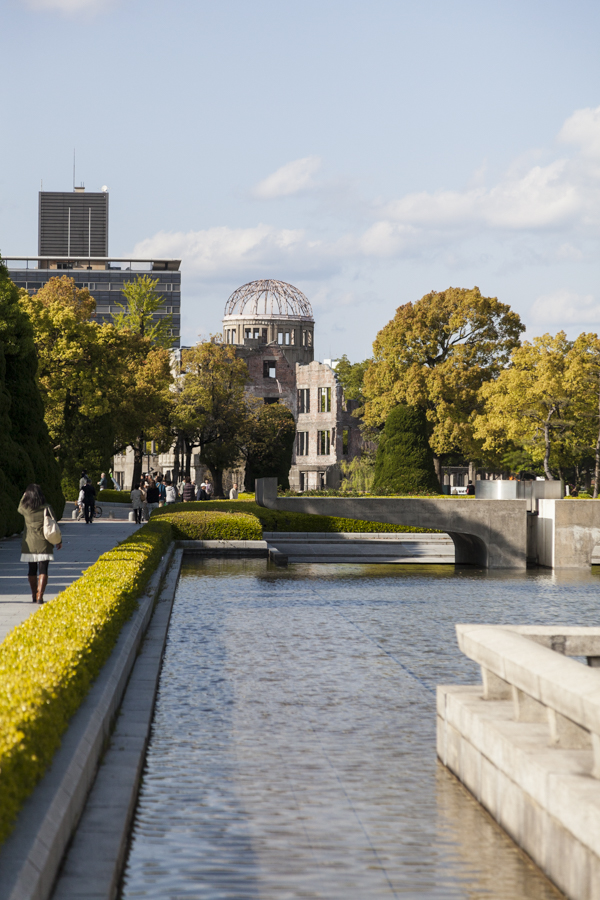
Take away the Dome Building from the background of pic 1 and the scene could resemble that found in many municipal parks around the world. However, Hiroshima’s Peace Park is no ordinary park, of which the Dome Building is the focal point and one of many memorials within the Peace Park.

Walking in the park

Walking in the park

Four years to the day after the bomb was dropped, the decision was taken to devote the area to peace memorial facilities – a major change from the area’s previous role as Hiroshima’s political and commercial centre. Construction of the park took place between 1950 to 1964 and for those interested in early footage of this period, I again refer you to the classic French movie titled “Hiroshima Mon Amour”.

This post shares images of some memorials and their significance, though I must qualify this by saying that their significance is most strongly felt on site.

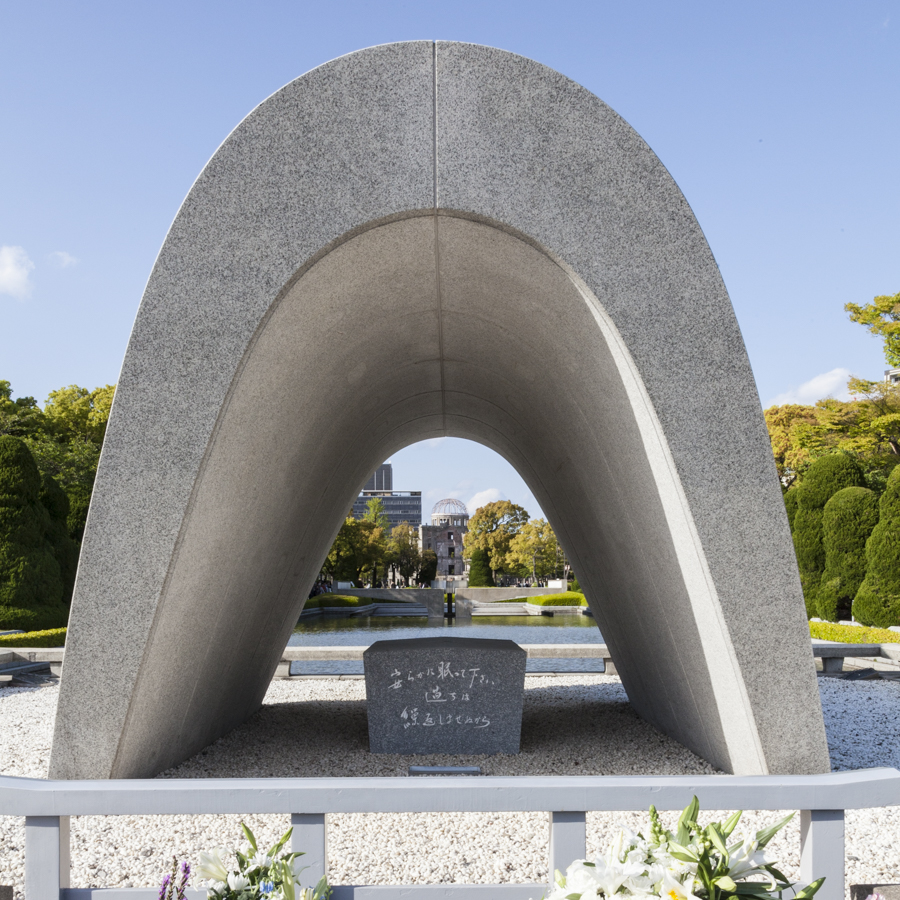
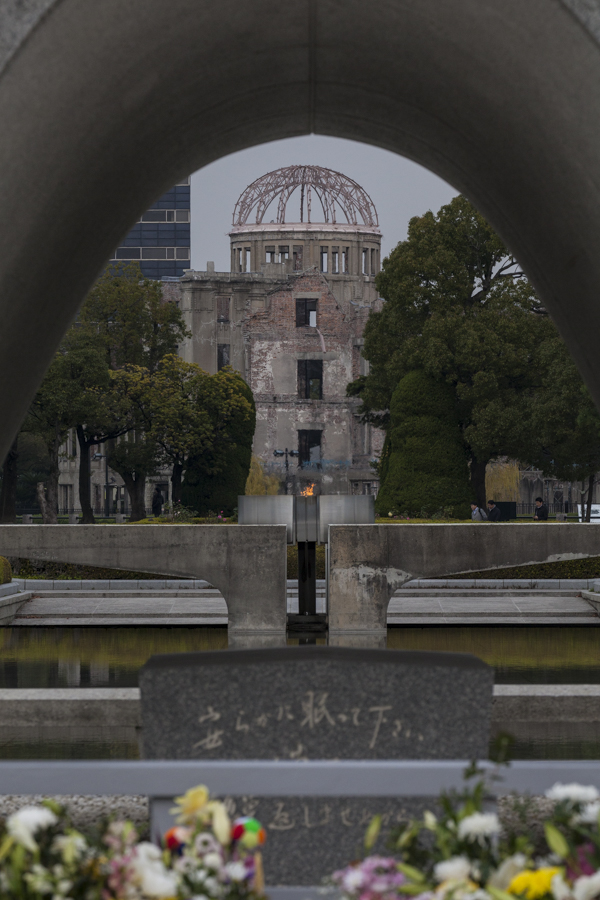
The Cenotaph for the A-Bomb Victims (pics 2 and 3) straddles a direct line of sight between the Dome Building and the Peace Museum. Below the arched tomb is a stone chest with a register of the names (more than 200,000) of those who perished in the initial blast or through subsequent exposure to radiation. At the centre of pic 3, one can see the Peace Flame, which has burned continuously since it was first lit in 1964. The Flame stands as a perpetual beacon for peace and will only be extinguished when all nuclear weapons are destroyed. Sadly, one must wonder if that will ever happen.

Cenotaph - pic 1

Cenotaph – pic 1

Cenotaph - pic 2

Cenotaph – pic 2

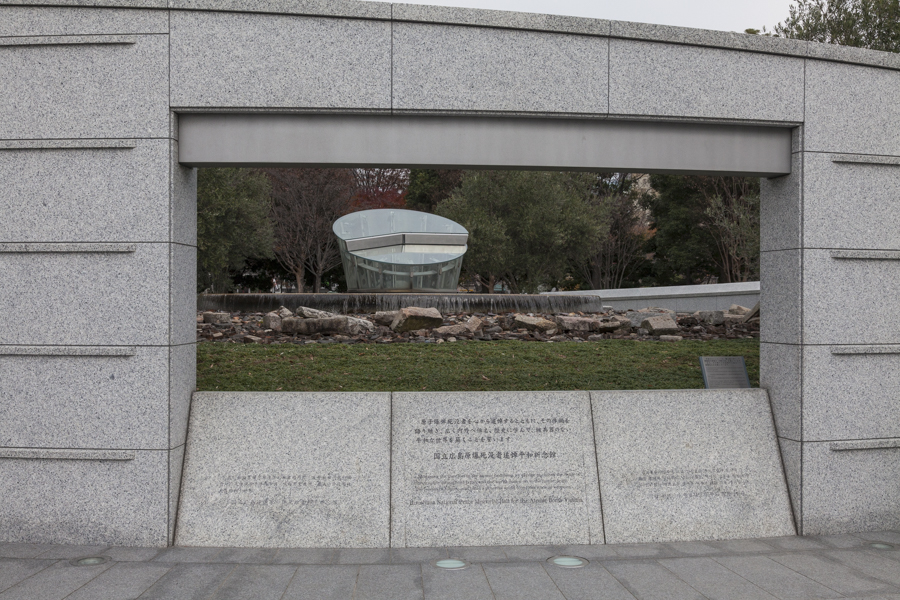
To the east of the Cenotaph lies the Hiroshima National Peace Memorial Hall, a beautiful yet sobering remembrance to the atomic bomb victims. On the roof of the mostly underground memorial (pic 4), one will observe the clock frozen at 8.15am to mark the time the bomb exploded and the cascading water, symbolic of survivors’ craving to quench their thirst.

National Peace Memorial Hall

National Peace Memorial Hall

Below ground the central feature is the Hall of Remembrance (pics 5 and 6), which features a 360-degree panorama of the destruction following the blast. To create the panorama, a total of 140,000 tiles were used to represent the estimated number of people who died from the bomb by the end of 1945. The depiction of individual victims through their photos on a bank of frequently refreshing screens (pic 7) communicates the personal cost of the tragedy and serves to remind us how many families must have been impacted directly or indirectly.

Hall of Remembrance - pic 1

Hall of Remembrance – pic 1

Hall of Remembrance - pic 2

Hall of Remembrance – pic 2

Hall of Remembrance - pic 3

Hall of Remembrance – pic 3

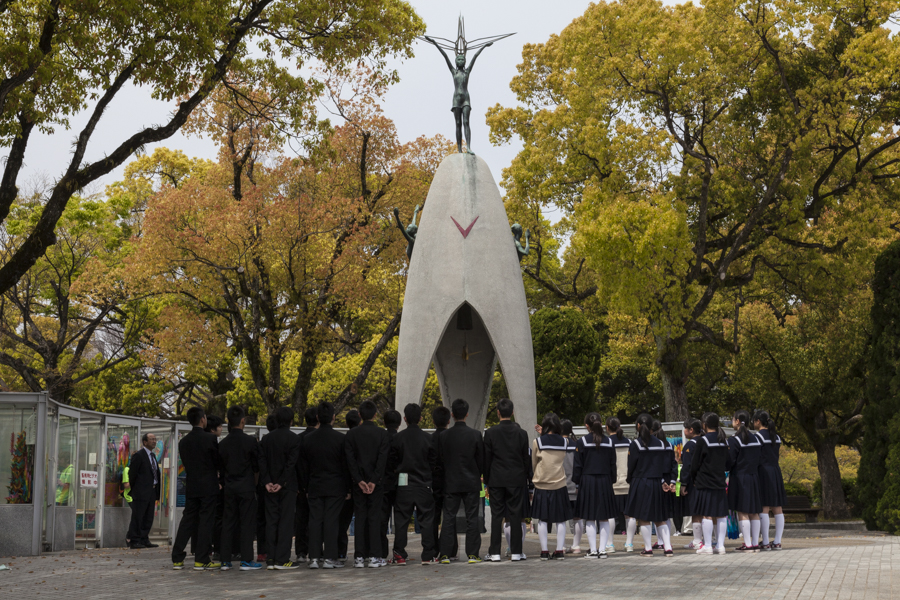
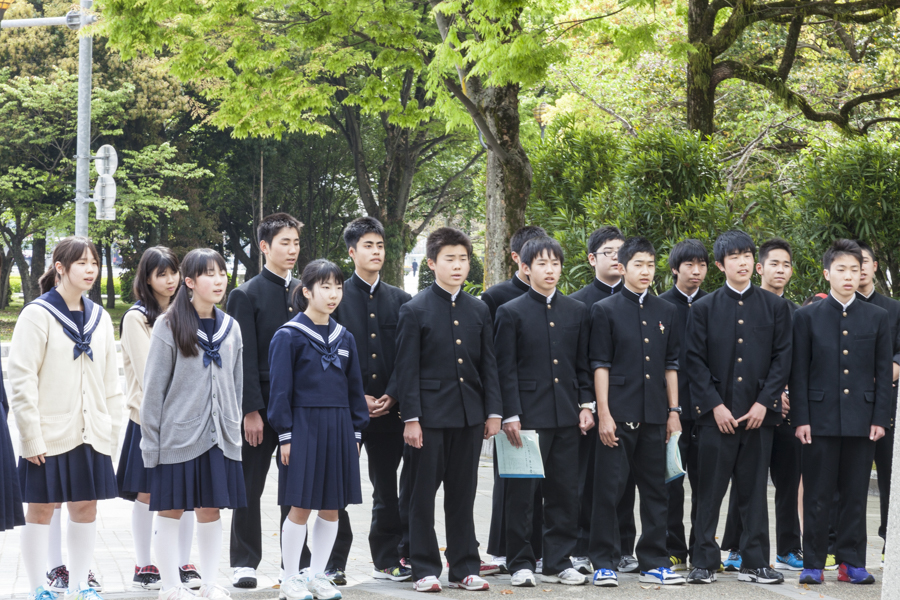
A particularly poignant memorial is the Children’s Peace Monument to commemorate the children who died as a result of the bombing. Pics 8 to 10 show a group of students paying tribute in a ceremony that ended with laying a bouquet of folded paper cranes at the base of the memorial. (I would have shared the moment photographically had an overly zealous teacher not blocked my view.)

The statue atop the monument shows a girl with outstretched arms, above which is the representation of a folded paper crane. This depiction was inspired by the true story of Sadako Sasaki, a young girl who had appeared to survive the blast only to succumb to a radiation related illness some years later. Sadako’s belief that by folding 1000 paper cranes she would be saved was sadly not enough to save her. However, her story lives on through the adoption of paper cranes (pic 11) as a symbol of peace. In fact, it is estimated that more than 10 million paper cranes per year are sent to Hiroshima, mostly from children around the world.

Children's Peace Monument - pic 1

Children’s Peace Monument – pic 1

Children's Peace Monument - pic 2

Children’s Peace Monument – pic 2

Children's Peace Monument - pic 3

Children’s Peace Monument – pic 3

Inspired by Sadako

Inspired by Sadako

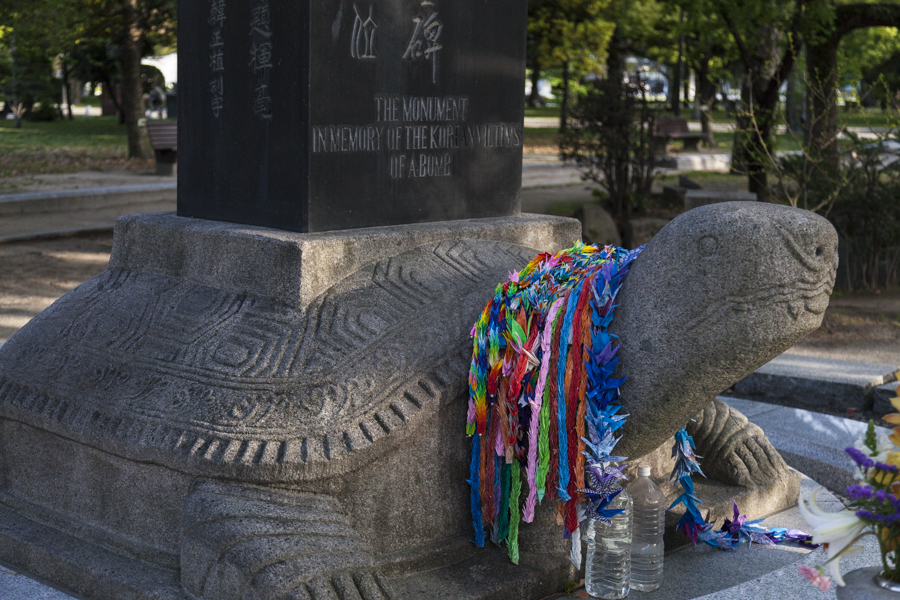
As one would expect, not all victims could be identified and the grassy Memorial Mound (pics 12 and 13) contains the ashes of an estimated 70,000 unidentified victims. Similarly, the number of Korean nationals who perished is uncertain and the Cenotaph for Korean Victims (pic 14) was created to honour victims and survivors from the bombing and from Japanese colonialism. An inscription on the statue reads “Souls of the dead ride to heaven on the backs of turtles”.

Memorial Mound - pic 1

Memorial Mound – pic 1

Memorial Mound - pic 2

Memorial Mound – pic 2

Monument to Korean Victims

Monument to Korean Victims

Two statues of very contrasting styles encapsulate the message of the Peace Park. The first is the “A-bomb Victim – the Monument of Hiroshima” (pic 15) located 141 metres south of the hypocentre by the bank of the Motoyasu River. The bronze sculpture remembers those victims who were killed instantly by the blast and serves as a graphic reminder of their horrific end. Although the sentiment behind the sculpture is positive, the twisted, distorted representation of the victim remains confronting. Further along the river, close to the Dome Building, one finds the statue of a girl and boy with the boy holding a dove (pic 16), which communicates hope for a peaceful future. These two contrasting sculptures that show the horror, yet advocate for peace is very much the message of the Peace Park.

Monument to A-bomb Victim

Monument to A-bomb Victim

To a Peaceful Future

To a Peaceful Future

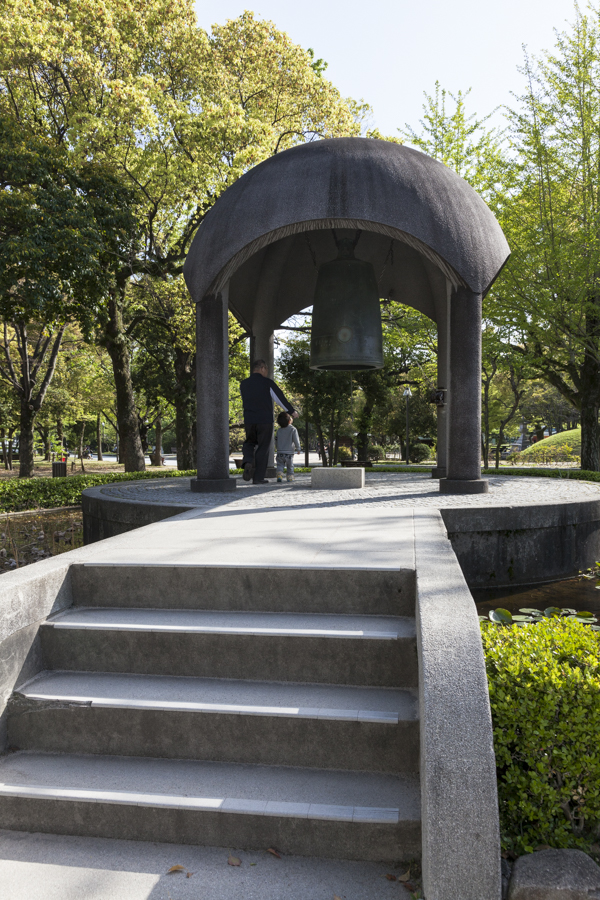
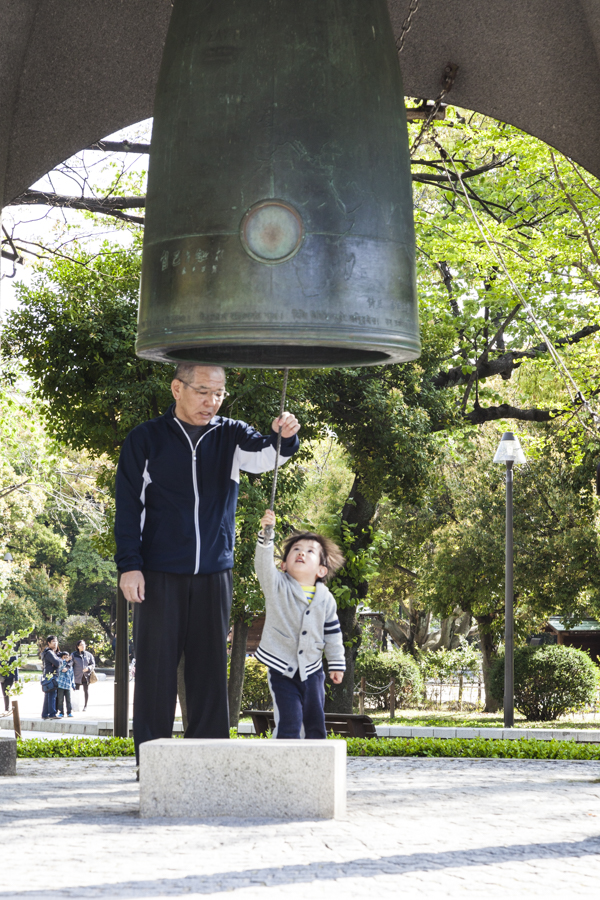
In conclusion, I would like to remember the resonant sound of visitors ringing the Peace Bell (pics 17 and 18) located near the Children’s Peace Monument. This is perhaps the most pleasing sound one hears in the Peace Park. The Bell, donated by the Greek Embassy, is inscribed in Greek, Japanese and Sanskrit characters, which translate to “Know yourself”. I rang the bell only once during my final visit as a mark of respect and to bid farewell to Hiroshima. Whilst I cannot speak for others, I found the experience of ringing the bell as akin to that of making a commitment to support the message of the Peace Park.

The Peace Bell

The Peace Bell

Ringing the Peace Bell

Ringing the Peace Bell

(Please click on any of the images for an enlarged view.)