johnliddlephotography

Frozen moments from the infinity that is time


2 Comments

Miyajima Walks

The best way to explore small islands such as Miyajima is by walking around and in this post I would like to share a selection of photographs taken during my exploration of the island. Some shots were taken around the island’s small town, but most are shots from time spent walking on Mount Misen, an enjoyable and sometimes arduous activity.

The graceful flowing lines of Japanese temple roofs is a sight I never tire of and when the thatched roofing materials can be shown in front of a natural forest (as in pic 1), the blending of man-made and natural structures is quite sublime. Maintaining this natural theme is the island’s houses (pic 2), which typically portray traditional Japanese styles utilizing materials such as wood and stone to great effect. Of course, this is accompanied by modern additions such as satellite dishes.

It is not unusual in Japan to come across small businesses supplying temples and shrines and as shown by pic 3, Miyajima is no exception. I have long admired Japan’s ability to maintain old skills and traditions, often through businesses passed down through many generations and when one consistently finds businesses of this type close to temples and shrines, it suggests a preference to support the work of local artisans.

As a protected site, the island’s deer population (pic 4) can be found everywhere from the peak of Mount Misen to wading through the waters at low tide near the Itsukushima Shrine. Perhaps I was just lucky during my visits, but the Miyajima deer seem to be less mischievous than their Nara counterparts. (Those who have visited Nara will know what I mean.)

The deer certainly handle the slopes of Mount Misen with greater ease than humans and although there are extensive paths to follow, care is often required to safely negotiate one’s climb and descent. Nevertheless, as can be seen from pics 5 to 9, Mount Misen is well worth the effort. When walking in Japan, a frequent sight is that of stone arrangements like those shown at pic 10. I don’t know if there is any special significance to the arrangements, or perhaps people simply like the challenge of creating and/or adding to little ornamental stone arrangements. Whatever its significance, it is an engaging form of communal art and entertainment.

The stone arrangements are again seen at pic 11, where Kannondo Hall in the foreground is said to be where prospective parents can ask for a safe childbirth, despite no births being allowed on the island. The building visible in the background is Monjudo Hall, where one can ask to be endowed with the ability to be a good student.

Further up the mountain, one finds Sankido Hall (pics 12 and 13), where it is believed one’s prayers for household welfare and business prosperity will be answered. On a practical level, Sankido Hall also serves as a welcome rest stop where one can enjoy a relaxing and contemplative break from the comfort of the welcoming Tatami flooring.

On the descent I came across a hall I failed to identify (pics 14 to 16) guarded by a couple of impressive, but fierce looking guardians. If anyone can provide further information about this building, it would be appreciated. I also found the sign made by the guardian’s right hand in pic 16 quite amusing given the penchant of the Japanese for hand signs. Perhaps it is more deeply ingrained in their culture than I realised.

What better way to end a walk around Miyajima than the shot of two young boys waiting for the ferry, looking happy and well stocked from their trip to the island.

(Please click on any of the following images for an enlarged view.)


2 Comments

Floating Torii and Itsukushima Shrine (Miyajima)

A short train journey of approximately 20 kilometres from Hiroshima followed by a ferry ride brings one to Itsukushima Island or, as it is more popularly known, Miyajima.

Even those with little knowledge of, or interest in Japan are likely to have seen photographs of Miyajima’s famous Floating Torii (also known as Otorii or Great Torii), which is acclaimed as one of Japan’s three most scenic views and said to be the most photographed structure in Japan. Now it is my turn to humbly add a few more.

When viewed from Mount Misen (pic 1), the Floating Torii can be seen about 200 metres out to sea in a direct line with the Honden (main hall) of the Itsukushima Shrine, which is similarly built over the water. The decision to build the torii and shrine over the water is testament to the sanctity of the island, which, since ancient times has been revered and worshipped as a sacred place. It was believed that locating the buildings over the water would allow Shinto followers to worship without despoiling the sanctity of the island. Although such beliefs and the strict rules governing access to the island have been relaxed over time, even today no births or deaths are allowed on the island.

The first Floating Torii was built in the 12th Century and the current structure dates back to 1875. To refer to it as “floating” is somewhat misleading in that Otorii rests on the seabed, where its solid structure and weight of some 60 tons provides ample stability. Included in the overall weight are seven tons of (fist sized) stones filling the box shaped upper section of the torii.

Prior to visiting Miyajima I had seen many brilliant photographs of the Floating Torii, yet when on site I found myself more interested in the torii’s relationship to its environment as shown at pics 2 to 5. I recall the thrill on my first visit of seeing the Floating Torii in the distance from the ferry terminal and watching it grow in stature as the ferry approached the island – an experience shared by many over the centuries. Similarly, when viewed from the island, one is drawn to thinking of how the mainland has changed over Otorii’s lifetime. In turn, one wonders how it will change in the centuries to come and it is comforting to think that a nexus will continue to exist between the ever-changing world on the mainland and the traditional past represented on the island.

Itsukushima Shrine stands in a protected cove, with all the shrine’s wooden buildings rising out of the sea, as can be appreciated from pic 6. At high tide, the entire shrine complex appears to float and at low tide, visitors and the island’s resident deer population can stroll on the sand between the buildings.

The accompanying photographs give some idea of this unique place, which includes the only Noh stage in Japan (pics 7 and 8) that rests upon the sea. I particularly like the way the stage blends with the beach and the surrounding hills (pic 8) to create a contemplative scene, hopefully being enjoyed by the lone person on the shore.

As with all shrines, they are functional places and during my visit a ceremony (pic 9) was underway. Connecting the mainland to the shrine is Sori-bashi (arched bridge) shown at pic 10, an imposing structure that is believed to have served as access for imperial messengers on important festive occasions. The bridge was first built around 1240, with the current bridge dating back to 1557.

Adjoining Sori-bashi is the Tenjin Shrine (pics 11 and 12) dedicated to a deity of education and intelligence. This building was constructed in 1556 and served as a venue for monthly Renga poetry ceremonies through to the middle of the Meiji period. To distinguish its later build, this building and the Noh Stage are not coated in the vermillion lacquer used predominantly across the Itsukushima Shrine buildings, but have been left untreated. This has allowed the timber to age naturally, which I found quite in keeping with the shrine’s exposure to the elements.

Whilst I did not visit the five-storey pagoda (pic 13), it is a prominent landmark built on a bluff overlooking the Itsukushima Shrine, first constructed in 1407. Finally, I end with a couple of shots (pics 14 and 15) of Otorii at low tide where it has sat majestically for centuries.

(Please click on any of the following images for an enlarged view.)


4 Comments

Shukkeien Gardens (Hiroshima)

This is the fourth and final post of my Hiroshima series. I realise that the subject matter has often been confronting, but I believe we must sometimes confront the horrors of the past to focus on a brighter future.

I am happy to end the series with a selection of photographs taken during a visit to Hiroshima’s Shukkeien Gardens. One may view the photographs as “pretty pictures” and that is essentially what they are. However, I ask that viewers consider the following facts about the Shukkeien Gardens.

  • Commissioned in 1620.
  • First opened to the public in 1940.
  • Demolished by the A-bomb on August 6, 1945.
  • Approximately 1.4 kilometres from the bomb’s hypocentre.
  • Victims took refuge in the gardens. Most died and their remains are interred there.

When viewed in this light, I see the gardens as a symbol of regeneration and a place that has once again become a happy place for residents of and visitors to Hiroshima. Even the high-rise buildings that overlook and somewhat diminish the ambience of the gardens can be viewed as a sign of a city moving forward.

To those who have viewed this series – thank you!

(Please click on any of the following images for an enlarged view.)


Peace Park Memorials (Hiroshima)

5 Comments


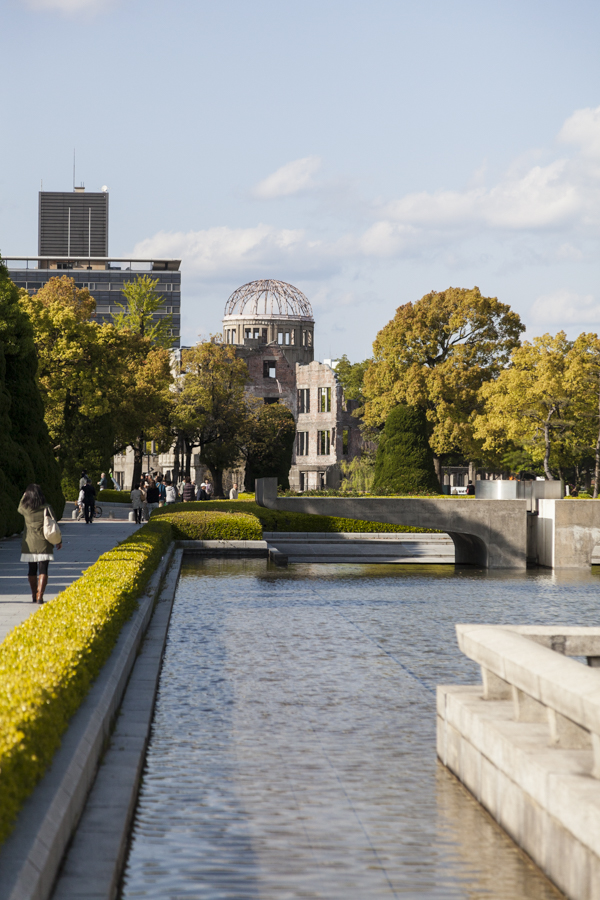
Take away the Dome Building from the background of pic 1 and the scene could resemble that found in many municipal parks around the world. However, Hiroshima’s Peace Park is no ordinary park, of which the Dome Building is the focal point and one of many memorials within the Peace Park.

Walking in the park

Walking in the park

Four years to the day after the bomb was dropped, the decision was taken to devote the area to peace memorial facilities – a major change from the area’s previous role as Hiroshima’s political and commercial centre. Construction of the park took place between 1950 to 1964 and for those interested in early footage of this period, I again refer you to the classic French movie titled “Hiroshima Mon Amour”.

This post shares images of some memorials and their significance, though I must qualify this by saying that their significance is most strongly felt on site.

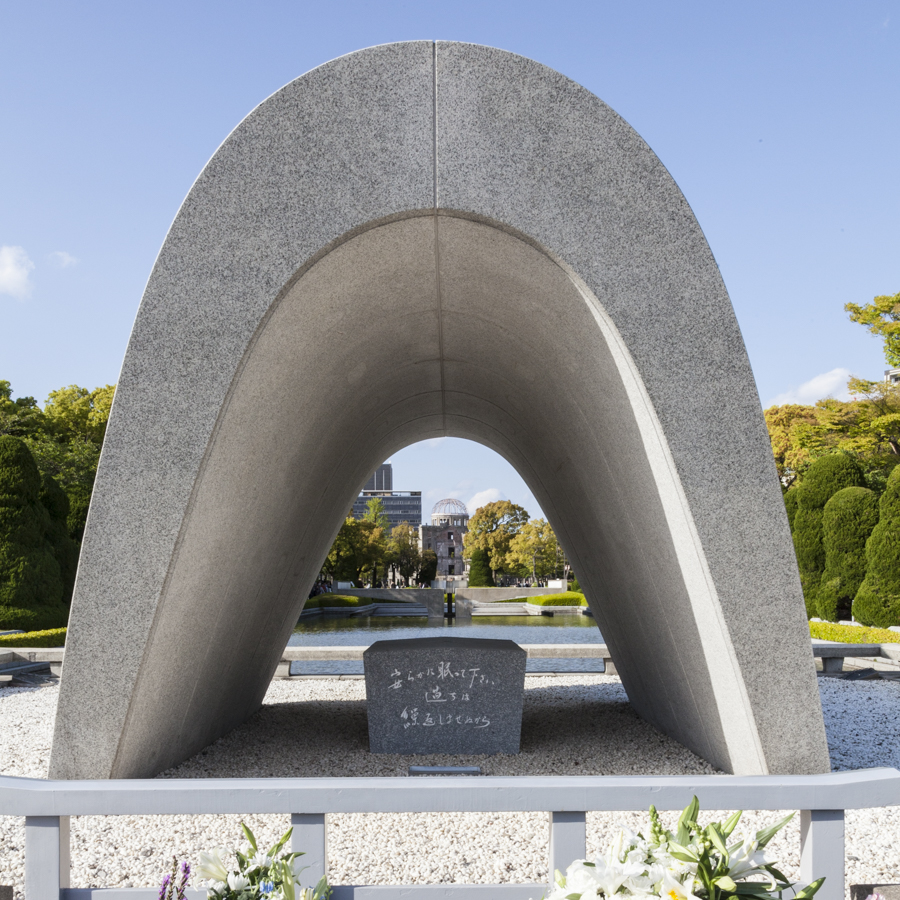
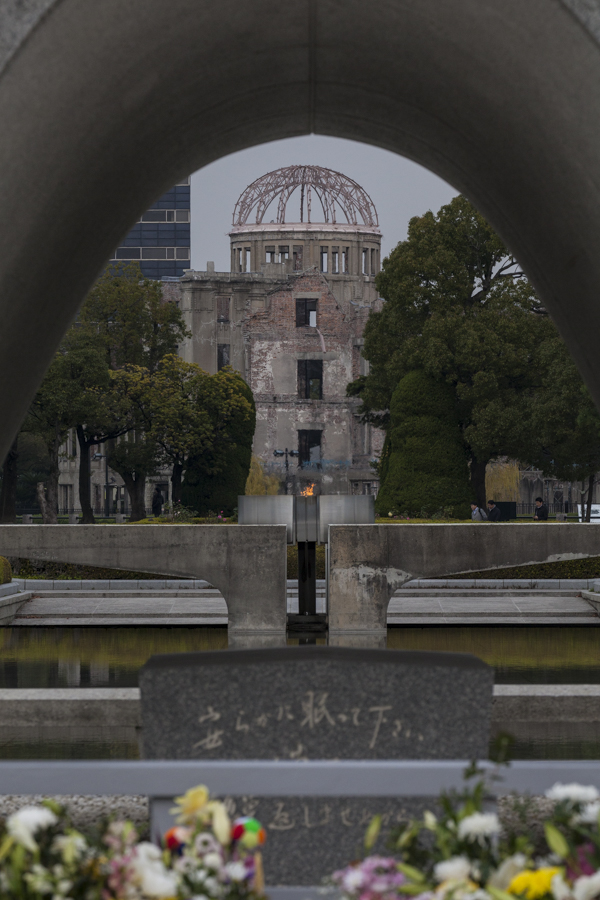
The Cenotaph for the A-Bomb Victims (pics 2 and 3) straddles a direct line of sight between the Dome Building and the Peace Museum. Below the arched tomb is a stone chest with a register of the names (more than 200,000) of those who perished in the initial blast or through subsequent exposure to radiation. At the centre of pic 3, one can see the Peace Flame, which has burned continuously since it was first lit in 1964. The Flame stands as a perpetual beacon for peace and will only be extinguished when all nuclear weapons are destroyed. Sadly, one must wonder if that will ever happen.

Cenotaph - pic 1

Cenotaph – pic 1

Cenotaph - pic 2

Cenotaph – pic 2

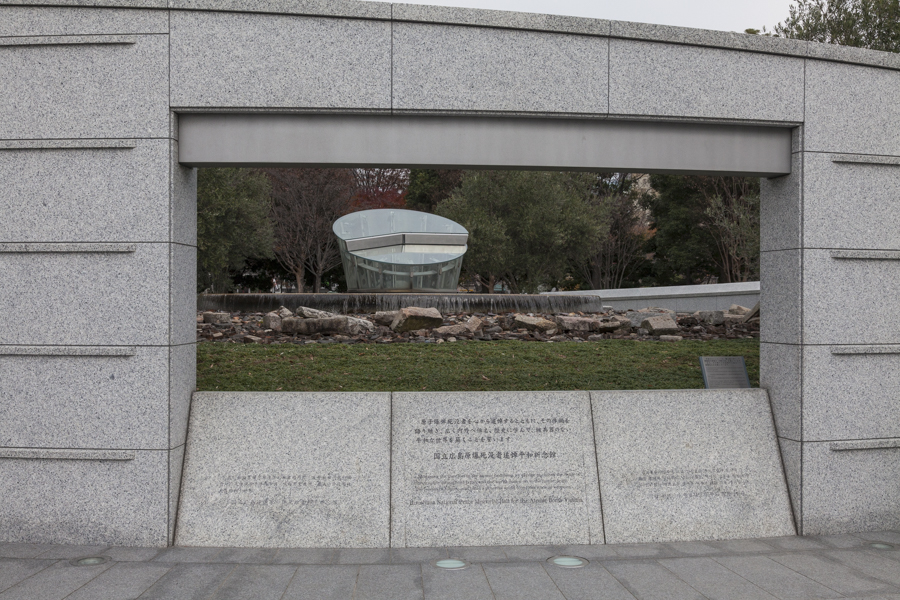
To the east of the Cenotaph lies the Hiroshima National Peace Memorial Hall, a beautiful yet sobering remembrance to the atomic bomb victims. On the roof of the mostly underground memorial (pic 4), one will observe the clock frozen at 8.15am to mark the time the bomb exploded and the cascading water, symbolic of survivors’ craving to quench their thirst.

National Peace Memorial Hall

National Peace Memorial Hall

Below ground the central feature is the Hall of Remembrance (pics 5 and 6), which features a 360-degree panorama of the destruction following the blast. To create the panorama, a total of 140,000 tiles were used to represent the estimated number of people who died from the bomb by the end of 1945. The depiction of individual victims through their photos on a bank of frequently refreshing screens (pic 7) communicates the personal cost of the tragedy and serves to remind us how many families must have been impacted directly or indirectly.

Hall of Remembrance - pic 1

Hall of Remembrance – pic 1

Hall of Remembrance - pic 2

Hall of Remembrance – pic 2

Hall of Remembrance - pic 3

Hall of Remembrance – pic 3

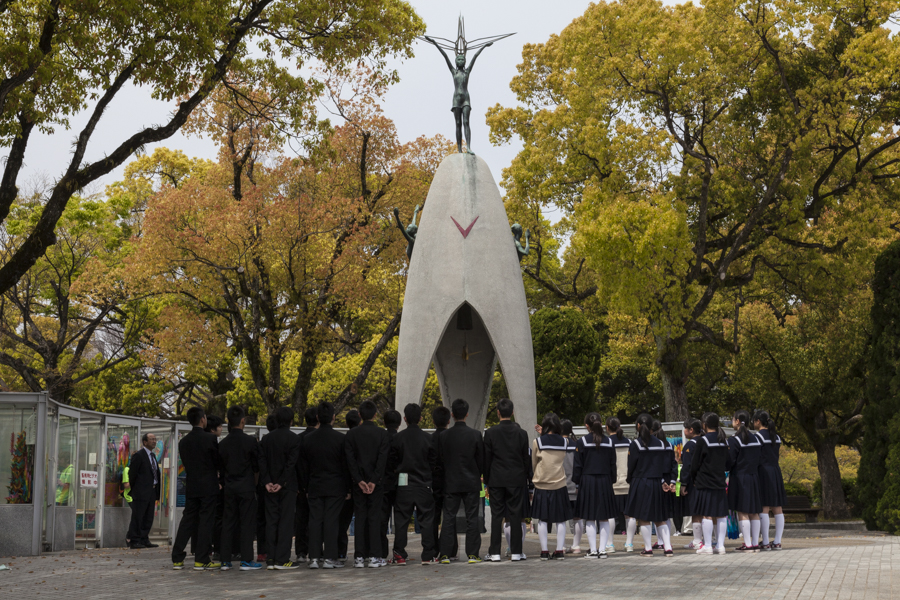
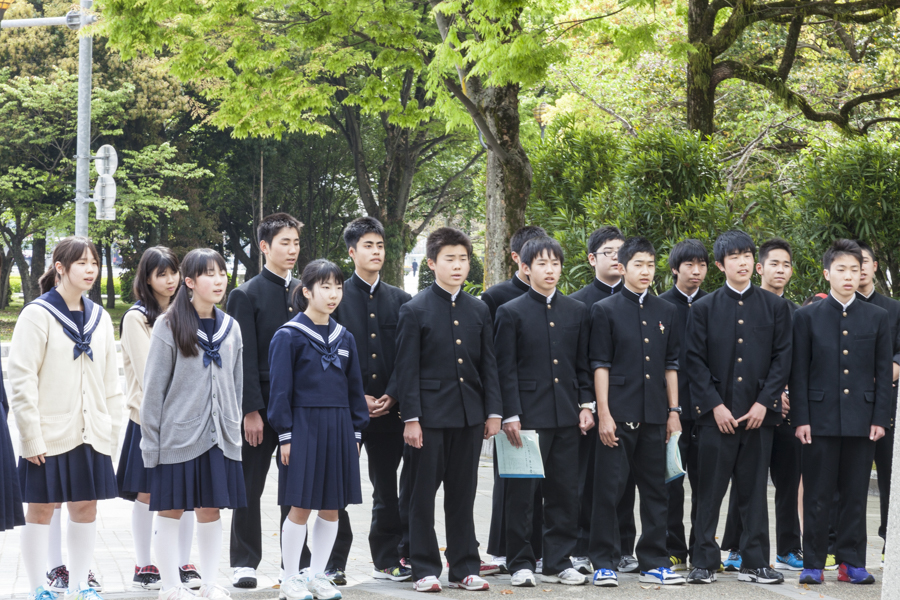
A particularly poignant memorial is the Children’s Peace Monument to commemorate the children who died as a result of the bombing. Pics 8 to 10 show a group of students paying tribute in a ceremony that ended with laying a bouquet of folded paper cranes at the base of the memorial. (I would have shared the moment photographically had an overly zealous teacher not blocked my view.)

The statue atop the monument shows a girl with outstretched arms, above which is the representation of a folded paper crane. This depiction was inspired by the true story of Sadako Sasaki, a young girl who had appeared to survive the blast only to succumb to a radiation related illness some years later. Sadako’s belief that by folding 1000 paper cranes she would be saved was sadly not enough to save her. However, her story lives on through the adoption of paper cranes (pic 11) as a symbol of peace. In fact, it is estimated that more than 10 million paper cranes per year are sent to Hiroshima, mostly from children around the world.

Children's Peace Monument - pic 1

Children’s Peace Monument – pic 1

Children's Peace Monument - pic 2

Children’s Peace Monument – pic 2

Children's Peace Monument - pic 3

Children’s Peace Monument – pic 3

Inspired by Sadako

Inspired by Sadako

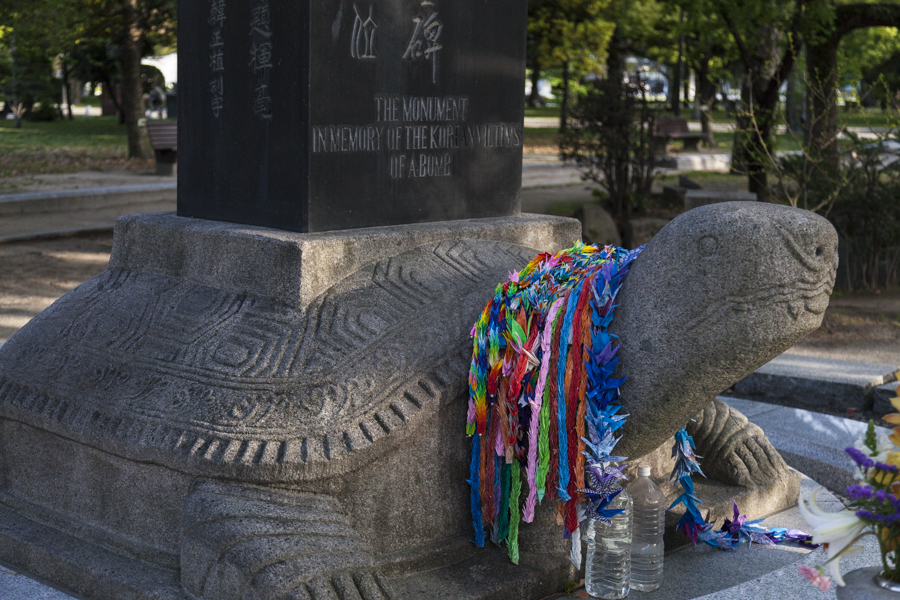
As one would expect, not all victims could be identified and the grassy Memorial Mound (pics 12 and 13) contains the ashes of an estimated 70,000 unidentified victims. Similarly, the number of Korean nationals who perished is uncertain and the Cenotaph for Korean Victims (pic 14) was created to honour victims and survivors from the bombing and from Japanese colonialism. An inscription on the statue reads “Souls of the dead ride to heaven on the backs of turtles”.

Memorial Mound - pic 1

Memorial Mound – pic 1

Memorial Mound - pic 2

Memorial Mound – pic 2

Monument to Korean Victims

Monument to Korean Victims

Two statues of very contrasting styles encapsulate the message of the Peace Park. The first is the “A-bomb Victim – the Monument of Hiroshima” (pic 15) located 141 metres south of the hypocentre by the bank of the Motoyasu River. The bronze sculpture remembers those victims who were killed instantly by the blast and serves as a graphic reminder of their horrific end. Although the sentiment behind the sculpture is positive, the twisted, distorted representation of the victim remains confronting. Further along the river, close to the Dome Building, one finds the statue of a girl and boy with the boy holding a dove (pic 16), which communicates hope for a peaceful future. These two contrasting sculptures that show the horror, yet advocate for peace is very much the message of the Peace Park.

Monument to A-bomb Victim

Monument to A-bomb Victim

To a Peaceful Future

To a Peaceful Future

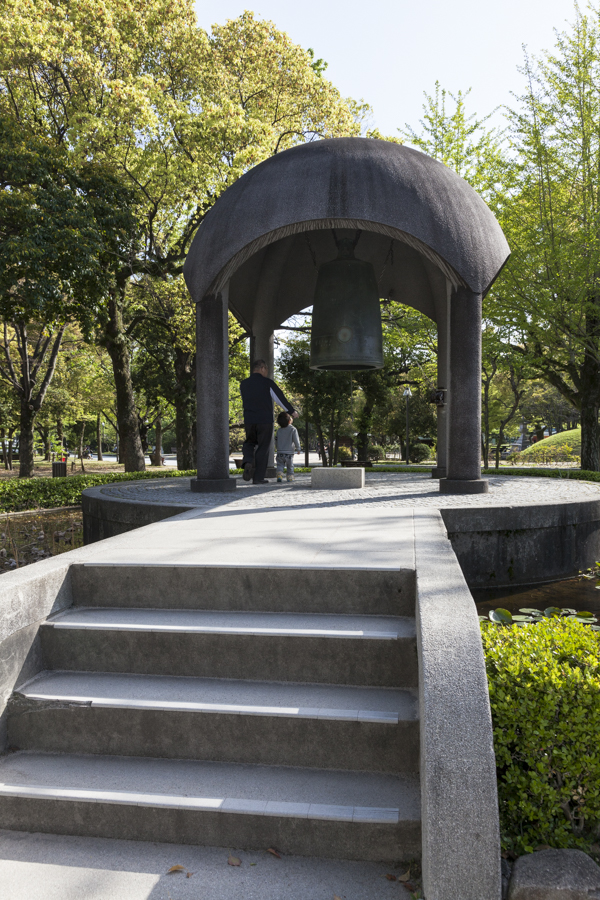
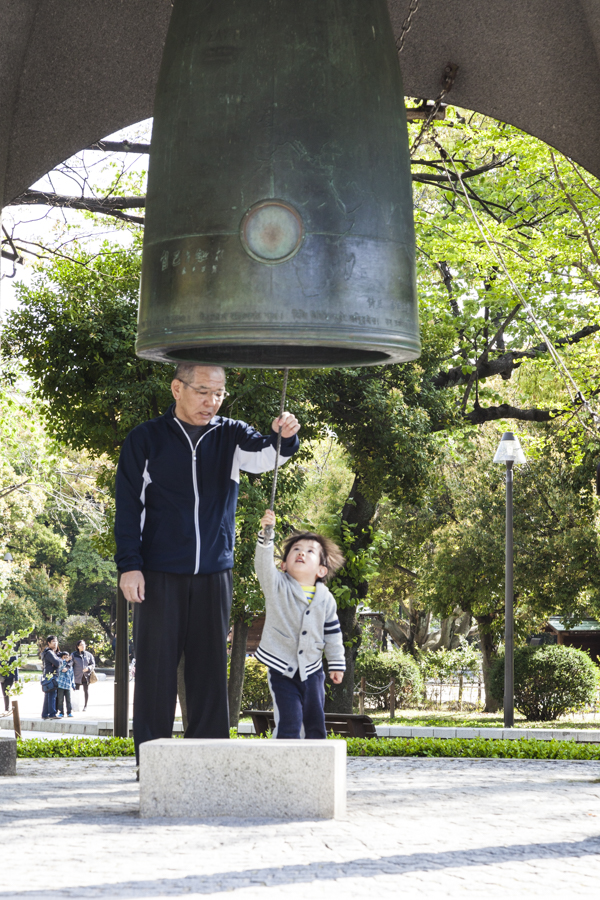
In conclusion, I would like to remember the resonant sound of visitors ringing the Peace Bell (pics 17 and 18) located near the Children’s Peace Monument. This is perhaps the most pleasing sound one hears in the Peace Park. The Bell, donated by the Greek Embassy, is inscribed in Greek, Japanese and Sanskrit characters, which translate to “Know yourself”. I rang the bell only once during my final visit as a mark of respect and to bid farewell to Hiroshima. Whilst I cannot speak for others, I found the experience of ringing the bell as akin to that of making a commitment to support the message of the Peace Park.

The Peace Bell

The Peace Bell

Ringing the Peace Bell

Ringing the Peace Bell

(Please click on any of the images for an enlarged view.)


1 Comment

Hiroshima Peace Museum

In my last post I described Hiroshima’s Dome Building as the most enduring symbol of the catastrophic events of August 6, 1945 when an atomic bomb was exploded over Hiroshima. Today, looking across the Motoyasu River from the Dome Building, the wasteland has been regenerated in the form of the magnificent Peace Park, at the end of which and in a direct line of sight to the Dome Building lies the Hiroshima Peace Museum (pic 1).

Peace Museum approach

Peace Museum approach

For those readers who would like to see vision of the Peace Museum soon after its opening, I suggest watching a classic French movie titled “Hiroshima Mon Amour”. As the title implies, the movie is set in post-war Hiroshima and the opening scenes contain some interesting footage, including a walk through the Peace Museum and some early footage of the Peace Park during development.

A visit to Hiroshima is incomplete without visiting the Peace Museum and my advice would be to allow more time than you may expect. Given the historic event it exists to portray, the Museum is confronting in the way it provides an accurate and objective account of the events of August 6 1945 and thereafter. In fact, the objectivity and lack of rancor in the presentation of the story is commendable and refreshing. The horror and atrocity is, of course, recognised and discussed, but most importantly the emphasis shifts to the need to learn from what happened and ensure that history is not repeated. It is a museum that should not be rushed and can be visited more than once.

Today’s photographs are mostly shots of Museum exhibits, including a number of archival photographs on display in the Museum. The pictures tell the story. The model at pic 2 shows the hypocentre of the blast as the red pole just to the right of the Dome Building where, it is estimated, the temperature would have approximated 4000 degrees Celsius. One can also note the intersection of the two bridges to the left of the Dome Building forming the T that was the target point for the Enola Gay’s bombardier.

One minute following the explosion, the mushroom cloud photograph (pic 3) was taken by Russell E Gackenbach; a crewman on the Necessary Evil, which accompanied the Enola Gay. It was reported by Russell Gackenbach that the crew’s return journey was made in silence after witnessing the event.

Whilst there is no need for further description of the pain and suffering depicted by pics 5 and 6, the obvious tenderness of the Red Cross nurse and the gratitude of her patient at pic 7 is a heartwarming image of the human spirit.

The series of shots (pics 10 to 16) titled Memories of the day give an insight into the minds of survivors and are particularly compelling when one considers the drawings and paintings were made decades later. One hopes the process of graphically sharing their recollections provided some level of comfort to the contributors, yet their clarity of memory is a frightening reminder of the lasting effects of traumatic events.

On a more positive note, pic 17 shows a 1956 photograph of Japanese students seeking support for the establishment of a Children’s Peace Monument. Their efforts were successful and photographs of the monument will be shown in my next post.

An ongoing role of the Peace Museum is to monitor nuclear testing internationally and via the Peace Watch Tower (pic 18) located in the Museum foyer, to display the number of days since the atomic bombing of Hiroshima and the number of days since the last nuclear test. At the time of posting this blog (August 15, 2014), the current figures are 24,923 days and 49 days respectively.

I strongly recommend anyone visiting Hiroshima to spend time visiting the Peace Museum and the other memorials within the Peace Park. Although the history is dark and sombre, its purpose is to advocate for an end to nuclear arms and a brighter, less oppressive future for all. I have never before written a comment in a Visitors Book. However, during my first visit, I commented to the effect that all newly elected politicians should spend a few days there before taking office, in the hope that they may better understand the futility of war. Perhaps the hope is futile, but who knows!

(Please click on any of the following images for an enlarged view.)


5 Comments

Time and Place (Hiroshima)

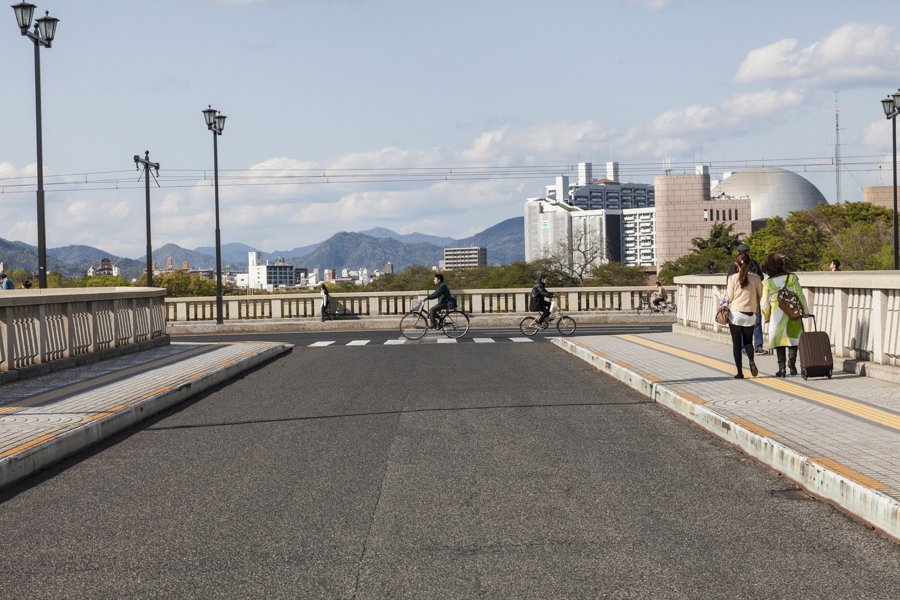
Please take a few moments to dwell on the first photograph, rather than dismiss it as merely a bland image of another Japanese street, free of litter and showing people going about their business in an orderly manner. View it as a photograph of time and place – two variables that have such a defining influence on our lives. Where would you rather be: the right place at the right time or the wrong place at the wrong time?

The T intersection

The T intersection

Everyone in the photograph was safe in that place and time. However, at the same place at 8.15am on August 6, 1945 the cyclist at the centre of the pedestrian crossing would have been the target for the bombardier on the Enola Gay, the US bomber assigned to drop an atomic bomb over the city of Hiroshima. A moment that changed the world forever!

The target point was the T-intersection more clearly shown in the archival photograph at pic 2, in which, coincidentally, a cyclist is at almost the same position. Today the two bridges forming the T look much the same and it is easy to forget the historical significance of the place. However, we should not forget how significantly life changed in a blinding flash, a memory poignantly captured by a survivor’s words reproduced at pic 3. From the archival images at pics 4 and 5, one can gain a sense of the destruction, as well as identify the most enduring symbol of the event – the Dome Building.

I was unprepared for my first visit to Hiroshima and the range of emotions one encounters by spending time in the proximity of the Dome Building. Despite having seen images and documentary footage and having a general understanding of the history, it was nevertheless a surreal feeling to be standing at the site of such a horrific event.

Although one tries to imagine what it would have been like, this is, of course, impossible. Some things are beyond imagination. The overpowering feeling was that of sorrow and if one is honest, a feeling of guilt by association of being a national from an allied nation. This took me by surprise. History positions the bombing as a necessary evil within the overall context of an even more horrific war, an argument that can be grasped intellectually. However, when standing at the scene, humanism outweighs intellectualism.

Almost seventy years later, the Dome Building (pics 6 to 16) stands as a reminder, but not the only reminder. Hiroshima continues to wear the scars in less obvious ways. The resilience of the people is commendable in the way they overcame the trauma to rebuild their city and their lives and the smiles of Hiroshima residents are the most genuine one will encounter. Nevertheless, the city presents differently to other Japanese cities.

Hiroshima is playing catch-up. One does not see the obvious lifestyle signs that one sees in (say) Tokyo and Osaka; one does not see as many glitzy high-rise developments; and even in the general demeanor of everyday life, one detects a more serious approach to life – as if the mission is unfinished. In a subsequent and longer visit to Hiroshima, I became more aware of signs that the city is poised to burst free and flower again. The mission is unfinished and below the surface bubbles a subdued excitement.

We must not forget Hiroshima. What happened there and at Nagasaki must never happen again and I firmly believe that awareness is the key to success. August 6, 1945 was a shocking start to the story, yet the real story is how the negative became a positive through people helping people and Japan becoming a strong advocate for peace and for the abolition of nuclear weapons.

Thank you for reading this far and if the subject is of interest, there is a considerable volume of information available online and in libraries around the world. I will be staying with Hiroshima for two or three more posts and I hope you will continue to show an interest. I read somewhere a criticism that Hiroshima was just emotional tourism (or words to that effect). Well, what is wrong with that? It does not hurt us to have our senses awakened to think about important issues. Maybe history keeps repeating because we forget. Let’s not forget this time.

(Please click on any of the following images for an enlarged view.)


2 Comments

Harajuku Lebels

In my last post we took a stroll through Harajuku and today we visit the Harajuku Lebels at play.

Last time the stroll started by exiting Harajuku Station and walking straight ahead and down Takeshita Street. Today we turn right after exiting the station and head up the hill towards Yoyogi Park, another of the expansive green spaces one finds within the Tokyo metropolis and an extremely popular venue at weekends for people of all ages.

Near the park entry one finds the Harajuku Lebels, who have staked out their play, or should I say performance space for the day. The Lebels are a group of Rockabillies who put on their own rock and roll dancing show to the sounds of old Elvis and other rock classics. I don’t know what they do during the week, though a Japanese person in the crowd told me they are mostly Salarymen who don their Lebels gear at weekends and transform into their 1960’s personas.

They attract a crowd; yet don’t appear to play to the crowd. In fact, they appear to be totally enclosed in their own little magic circle that becomes their world for a few hours at a time. They dance with each other and for each other. Moves are taught and practiced and the camaraderie within the group is evident. Performances have an impromptu, almost jazz like feel to them. Dancers doing a solo routine will be joined by others, from which choreography equivalent to session musicians jamming will emerge.

Black is the preferred colour, most aptly captured at pic 2 where the young woman’s long black hair complements the black on black look perfectly. However, black is not compulsory, as one can see from several photos featuring the tattooed dancer in blue jeans, who seemed to be, if not the leader, the dominant player within the group. As in all areas of life, dominance Invites challenge and in this case, the dancer featured in pics 3 and 4, who, to my inexpert eye, was the best dancer of the day, gave the impression of staking his claim in a friendly way.

Dancing is hot work and the group worked their way steadily through a lot of beer in their own unique style. Beers were distributed by one dancer opening a can and throwing it in a high arc to another dancer who, except for one mishap, would expertly catch the can and quench their thirst. As you may imagine a lot of beer was spilt in the process.

I couldn’t help noticing a couple of other things. Firstly, several of the dancers had wallets or other items in their back pockets (as in pic 13). This is not an unusual sight in Japan, whereas in most places it would be akin to an invitation to be robbed. Secondly, the dancers were doing it purely for their personal enjoyment and nowhere around their magical circle was there hats or tins to collect donations from spectators. Even watching a group of Rockabillies contains cultural messages.

Apart from references already made to some photographs, the selections speak for themselves – a group of friends having fun doing what they enjoy and entertaining others in the process. Sounds like a win/win.

(Please click on any of the following images for an enlarged view.)


2 Comments

Harajuku

I first heard of Harajuku long before I visited Japan through the term Harajuku girls. The term is used to describe those (predominantly teenage girls) who enjoy dressing in theatrical costumes to take on the aura of real or fictional characters.

In the past Harajuku was a gathering point for this genre, particularly at weekends and although they are still to be seen, it would seem the popularity of garish dressing is on the decline. The area’s popularity inevitably attracted the attention of large international chain stores, which now compete with the edgier independent fashion stores for the patronage of the fashion and trend-conscious youth market. Nevertheless, Harajuku remains very much a youth oriented area and a major hub for youth culture and fashion.

Geographically, Harajuku is a relatively small area roughly covering the area between Harajuku Station and Omotesando, a more up-market area where one can find many high-end luxury brands. At this point, I should acknowledge that those who know Tokyo well would recognise that some of the photographs in this post are within Omotesando. However, geographic boundaries are often blurry and they are included as being more Harajuku in style.

Most people travel there by train and the first view is from the station platform (pic 1) looking directly down Takeshita Street, the must-see inclusion in any visit to Harajuku. Exiting the station, follow the pedestrian crossing (pics 2 & 3) directly to Takeshita Street, which is really more of a laneway with shops (pics 4 to 6) on either side. Be prepared for a crowd if visiting on a weekend (pic 7), though during the week there is more room to move (pics 8 & 9).

It’s a good place for people watching and one encounters interesting casts of characters such as those in pic 8. There is the Salaryman in his business suit seemingly interested in nothing but his mobile phone; the young attractive woman presumably wanting to be noticed and the young guy on the left who maybe doesn’t want to be noticed. This assortment of characters is typical of Tokyo where, no matter what an area’s dominant demographic might be; one invariably finds a cross-section of people from different walks of life, including those with interesting pets (pic 11).

The area also has entertaining buildings worth a second look. We often hear that land is scarce in Tokyo and perhaps one should not be too surprised to find a three-level café built from (or at least inspired by) shipping containers (pics 12 & 13).

Another standout building is The Watari Museum of Contemporary Art (pics 14 & 15), one of Tokyo’s leading contemporary art galleries. I recall turning my head when I first drove past in a taxi upon my arrival and immediately made a mental note to find the place again. As well as attracting attention to the Museum, one must applaud their promotion of art in this way. If one is wondering what the faces are looking at, the answer is on the other side of the street (pic 16). By the way, pics 16 to 18 are what I meant by Harajuku style in Omotesando.

To conclude this little walk through Harajuku I could not resist snapping the photographer on an overpass setting up his large frame camera (pic 19). What was he photographing? The Sunday afternoon crowds outside Harajuku Station of course (pic 20).

(Please click on any of the following images for an enlarged view.)


4 Comments

Geisha Blur

Blur is not a word one normally associates with geisha, yet it aptly describes my most valued sightings of geisha from dusk onwards when their focus is getting to their next appointment. This is their busy time and in an evening with several bookings, time is money and they are ladies in a hurry. Sightings can be a “where did she come from?” experience as they pass in a blur of colourful elegance, appearing to float above the pavement with their short, quick steps.

Pics 1 to 3 are examples of geisha blur, all shot in Kyoto’s Gion district. Sadly the Geiko shown in pics 1 and 2 show signs of unwanted attention and it was disappointing to witness the lack of respect shown by many people obstructing their path and popping flashes to get the souvenir shot. Nevertheless, their grace shines through. I did not travel with a flash unit and was happy to record the blur, nor did I elect to join in chasing, which is why pic 3 shows a Maiko moving away. It is unfortunate that a frontal shot was blocked, as she was the most beautiful Maiko I saw. However, there is a certain pleasure in accepting blur as the trade-off for retaining one’s dignity. (I guess a career as paparazzi is out of the question.)

To stay with this theme, one must understand that geisha are celebrities with a difference. Their celebrity is an inheritance from being the current custodians of a traditional entertainment form unique to Japan. Indeed, in my opinion, geisha represent Japan’s most recognisable icon. Unlike western celebrities who seemingly crave attention, geisha go about their business in a quieter, more refined manner. However, their time-honoured practice of walking to appointments means that they are frequently exposed to an adoring and curious public.

Much has been written about the world of geisha, yet so much remains unknown. Retaining an element of mystery and intrigue is essential, but I would like to touch on one aspect that tends to be somewhat overlooked.

A general perception of Japan is that of a male dominated society and there is much to support this perception. Yet the geisha culture challenges this perception. The world of geisha is female dominated, with men occupying specific roles such as dressing, where strength is required to perfectly arrange a geisha’s apparel. The okiya within which geisha live and train under the guidance of an Okasan (mother) is exclusively female and most importantly, the Tea Houses (ochaya) where geisha entertain have traditionally been female owned and operated. I find it fascinating that this most feminine of Japanese cultures has emerged from a male dominated society and whilst geisha do not openly associate with feminism, their achievement is significant.

Pics 5 to 7 are of a young Maiko in Kyoto during the cherry blossom season. I gained the impression that she was somewhat uncomfortable in the public spotlight and perhaps she had not yet realised her powers.

Pics 8 and 9 are of a Tokyo geisha, shot in the late afternoon on her way to a nearby ochaya. Tokyo geisha are more elusive than their Kyoto counterparts and these shots were my reward for several hours spent wandering the streets of Mukojima. It was an enjoyable time as Mukojima is one of Tokyo’s older areas and although my primary focus was to see geisha, the area is interesting in its own right. After wandering for some time, I came across an area that simply felt right and decided to hang around for a while. (Maybe there is a bit of paparazzi in me after all.) A short time later, I heard the distinctive clip clopping and jangling sounds and there she was coming in my direction. My satisfaction with the day’s shoot was heightened after speaking with some Tokyo residents who advised that many people live for years in Tokyo without ever seeing geisha. Maybe I got lucky.

The final photograph (pic 10) of the older woman in kimono was taken shortly after pics 8 and 9. The wrapped object the lady is holding is a shamisen, a stringed Japanese instrument, which she plays as accompaniment for geisha performing dances. I would have liked to know if she had once been geisha, but alas, my Japanese language skills were inadequate.

It is always a special experience when one encounters geisha, whose numbers are unfortunately declining. One hopes this decline can be arrested and their place in Japan’s traditional art forms can be forever ensured. There are traditions that should never be lost. Geisha is one such tradition.

(Please click on any of the following images for an enlarged view.)


4 Comments

Gion

I have heard Kyoto described as “old Japan” in contrast to Tokyo being seen as “new Japan”. Like many generalisations, such descriptions may be seen as unkind and incomplete summations of each city given that each sits comfortably in the 21st century and embrace, in that very Japanese way, the old and the new. Nevertheless, differences in the relative emphasis assigned by each city to the old and the new tends to support these broad classifications, as is supported by the preponderance of world heritage sites in and around Kyoto.

Through previous posts I have shown several of Kyoto’s world heritage listed sites and will show more in future posts. Today, however, I wish to focus on the area that has been Kyoto’s gathering place through the centuries and continues to be so today. The place I am talking about is, of course, Gion.

Its history is too deep to cover in this brief discussion and I will leave readers to pursue their own enquiries, preferring instead to talk of my own experiences.

My first morning in Kyoto was spent in Gion and perhaps it was the chance meeting with a Geiko (Kyoto term for geisha) that cast its spell over me. From then, the place was like a magnet and it seemed that at some point of each day I would find myself somewhere in Gion. This was not always planned, but Kyoto is a great city to explore on foot and many paths lead to and/or from Gion.

In its heyday Gion was a maze of narrow streets filled with traditional wooden buildings and home to many thousands of geisha. If time travel were a reality it would be at the top of my time travel bucket list. Times do, of course, change and with tourism comes commercialisation. However, old Gion remains. The streets and alleys are still narrow and if one can ignore the modern additions such as power lines, a sense of the old maze and its charm can be felt. It is not a place to visit with a guidebook and a list of sights to see. It is a place in which to wander, get lost and keep wandering until you find your way.

The selected photographs attempt to show old and new Gion, though I openly admit they do not do justice to the place. The tea-houses by the canal (pic 1) attract an up-market clientele where geisha entertain. In fact, pic 2 shows a Geiko and Maiko (apprentice geisha) on their way to the tea-house in the foreground of pic 1. One can only wonder how many Geiko/Maiko have and will continue to walk this street. For me, pic 2 is a reminder of a lost opportunity. I was lost in concentration setting-up another shot with the camera mounted on a tripod when I became aware of movement behind me. On turning around I was greeted by the graciously smiling white painted faces of a Geiko and her Maiko sister en route to their appointment. There was only time to settle for exchanged greetings as they passed, hence the shot of them walking away.

Pics 3 to 5 show other examples of the warm, welcoming atmosphere created by the elements of old wooden buildings, cobbled streets, trees and water. To round off the older style images, pic 6 shows the Minamiza Kabuki Theatre, Kyoto’s premier kabuki theatre located in an always bustling section of Gion.

As mentioned earlier, Gion is a major tourist attraction and pics 7 and 8 give some indication of its popularity. Pic 9 shows the same street with fewer people, but what is interesting is how the young Maiko is the focus of attention. Although the kimono worn by regular Japanese women do not match the finery worn by geisha, one does see more kimono worn around Gion than elsewhere in Japan (at least in my experience). Typical examples are those of the kimono clad women in pic 11 enjoying a stroll through one of Gion’s many winding laneways and the young women (pic 12) disappearing into an alley, framed again by those typically Japanese building elements of paved stone and wood.

For those readers who have visited Gion I hope these images may spark some pleasant memories and for those who have not visited in person, I hope this little glimpse may spark some interest.

(Please click on any of the following images for an enlarged view.)