johnliddlephotography

Frozen moments from the infinity that is time


1 Comment

Sanmon Gate (Kyoto)

We are all familiar with gates … house gates, station gates, security gates etc.  Kyoto’s Sanmon Gate is altogether different.  In fact, it is a gateless entry to the most sacred part of the Nanzen-ji Temple, which has been at the core of Japanese Zen history since 1386.

The Sanmon Gate is an impressive wooden structure constructed in 1626 and supported by massive wooden pillars that dwarf those passing through its five bays.  One cannot help but feel humbled by such scale and reminded of the opportunity afforded pilgrims to free themselves from the three passions of greed, hatred and foolishness.

As will be seen from the photographs, the Sanmon Gate also serves as a meeting place and a place for reflection, particularly during the cherry blossom season when it becomes a popular platform for hanami (cherry blossom viewing).

Readers who enjoyed the movie Lost in Translation may also recognise the location from the scene where the Scarlett Johansson character (Charlotte) is entranced by witnessing a Shinto wedding group during a day trip to Kyoto.  I’ve only ever seen Shinto weddings at shrines rather than temples, but Hollywood is Hollywood and I still enjoyed the movie.

(Please click on any of the following images for an enlarged view.)


6 Comments

Fushimi Inari Shrine (Kyoto)

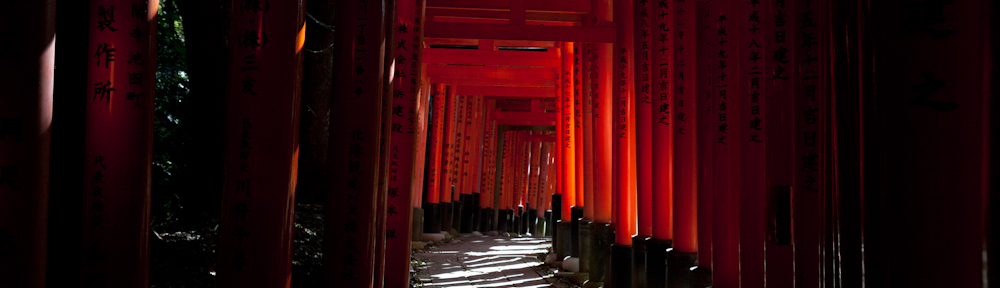
A short train journey from central Kyoto, the Fushimi Inari Shrine is one of Japan’s best known and most venerated shrines.  With its thousands of vermillion coloured torii gates, its impact is both immediate and lasting – particularly for those who allow themselves to be drawn through the gates to explore further.

Torii gates mark the entrance to Japanese shrines and there are many impressive torii gates throughout Japan.  However, nowhere else does one find so many torii in one place.  Each of the Fushimi Inari gates has been donated by a company or an individual seeking good fortune from Inari – the god of rice.

With trails leading up and around a low mountain offering wonderful views over Kyoto, a visit to Fushimi Inari can involve a lot of walking.  I found the various trails to be irresistible, which led to my becoming lost at one point and ending up outside the shrine area.  However, after teaming-up with some Mexican travelers who were similarly lost, together we found our way back.  In fact, getting lost must be easy as several Japanese people asked us for directions.  One presumes they were visiting from elsewhere in Japan.

Readers who remember the movie Memoirs of a Geisha may also remember the scene of the young Sayuri running between Fushimi Inari’s torii gates dreaming of her future life as a geisha.  Perhaps the scene had a healthy dose of poetic licence, but it nevertheless shows the ability of the location to inspire.

(Please click on any of the following images for an enlarged view.)


Leave a comment

Tsukiji Fish Market

I confess!  This is a photographic blog about the world’s biggest fish market without any photos of fish.  However, who needs fish?  This market, like famous markets everywhere, is about its people.  Those who work here, shop here and pass through on the way to or from somewhere else.  Among other things, Tsukiji is another piece of the Japanese food experience and is a popular breakfast venue, as shown by several photos of people hunting for breakfast and their providers.

The basic tool of trade is, of course, the knife – another area where Japanese craftsmanship is revered.  A good blade is essential and the knife sharpener (pic 6) and the knife merchant (pic 7) are integral to the market’s operations.  I was also fascinated by the clerks (pics 9 & 10) who were totally absorbed in their work.  They rarely look up and would seem to rely on old skills and technologies to keep business running smoothly.

Tsukiji is an old market and as shown by pics 1 & 12 and is very much a working place that wears its scars, through which its story can be imagined.  Trolleys like the one in pic 11 symbolise this and although well worn from years of daily hard work, it retains an honest beauty.

All things come to an end and like other great markets in London and elsewhere, Tsukiji Fish Market will soon relocate to enable its prime location to be redeveloped.  Perhaps in time the new market will also capture our imagination, but for now I’m pleased to have my memories and photos of how people working from a collection of big, untidy sheds have created a much-loved institution.

(Please click on any of the following images for an enlarged view.)